
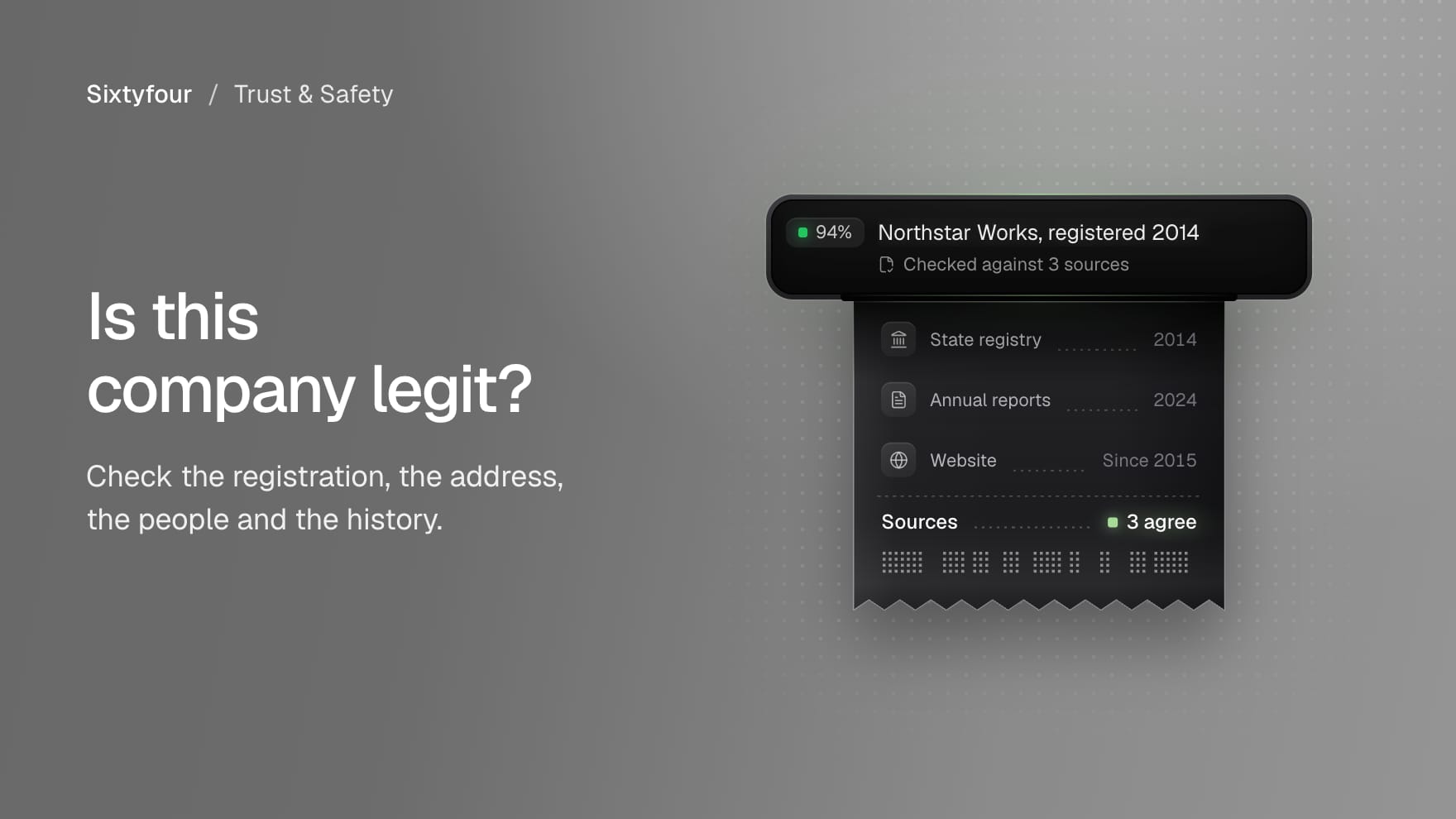
To check if a company is legit, look it up in the official business registry where it says it was formed and confirm it is active, then check that the record matches the name, address and people it gave you. Then check what the registry cannot show: that the company's website and other people's mentions of it are as old as the history it claims, that the people it names exist and work there, and that nothing says it is a different business. Sixtyfour, our research agent, runs the research behind those checks: give it a company's name and website, and it returns what it found about the company's history, address and people, each finding with its source.
This guide is for anyone about to sign with, pay, partner with, buy from or work for a company they do not know. Our other guides go deeper on particular cases: verifying a vendor before you pay them, KYB verification for onboarding business customers, shell company red flags, verifying a business address and business identity theft, where a real company's identity is borrowed.
What does it mean for a company to be legit?
A legit company passes two tests. It is real: it exists as a registered entity, its registration is active and it operates. And it is the company it says it is: the name, address, people and history it gives you belong to that entity. A company can be registered and active and still not be the company it describes.
Five questions cover both tests, and the sections below take them in order:
- Is it registered, and is the registration active?
- Does the registration match the name, address and people it gave you?
- Is its web presence as old as the history it claims?
- Do the people it names exist, and do they work there?
- Does anything say it is not real, or not the business it describes?
The FBI's Internet Crime Complaint Center received 56,478 complaints in its non-payment and non-delivery category in 2025, with reported losses of $503.4 million, according to its 2025 annual report. The category covers payment sent for goods or services that are never received or are of lower quality, and goods or services supplied and never paid for.
How to check if a company is legit with Sixtyfour
Sixtyfour carries out the research, starting from what the company gave you.
- Company Intelligence takes the company's name and website and researches the company. You name the answers you want as fields, such as when the business first appears outside its own website, what is at the address it gives and whether it connects to an older company of the same name. It returns the fields with a short research summary of how each value was established, and the source URLs behind them with what each one supports. With
find_peopleon, it also returns the people it finds there, with their titles and profiles. - People Intelligence takes a name the company gave you, such as its founder, with the company's name, and researches where that person works today and has worked before, with sources.
- Reverse Lookup takes an email address or phone number from the company's messages and returns the person behind it, with their name, employer and profile, or no match. Verify Email checks whether an address can receive mail.
Each result also carries an overall confidence score, and field confidence scoring, offered on the original Intelligence routes, gives each field a 0 to 100 score, a short justification and the pages it was read on. Anything Sixtyfour could not establish is reported as open, and a person on your team decides.
For a large contract, an analyst can open the company as an investigation in Atlas, enabled on request, where research agents build an attribution graph that links every finding to its source, then write a report. Teams that check many suppliers can call the same research through the Research API, and Monitors, enabled per organisation, recheck the fields you watch on a schedule and record each change with its sources.
Some checks stay with you: the registry search, which is often free, the domain's creation date, older copies of the website in a public web archive, a reverse image search of its photos, and a call to a phone number you found yourself.
Is the company registered and active?
Start with the registry where the company says it was formed. In the US that is a state registry, usually run by the secretary of state, and the National Association of Secretaries of State links to each state's "business registration pages and corporate name databases". Search the name without its ending, such as LLC or Inc., so that close variants come back too.
Registries differ in what they show for free.
- Delaware's entity search gives "the entity name, file number, incorporation/formation date, registered agent name, address, phone number and residency" free of charge. It returns active and inactive entities together, and says the list "is not an indication of the current status of an entity". An online status check costs $10 an entity and a certificate of status $50, as of November 2026.
- California's business search shows each entity's registration date, status and agent for service of process, according to its field definitions, and the Secretary of State's FAQ says it holds information on officers, directors, managers and members.
- In the UK, Companies House's free service shows a company's registered office, its status ("for example live or dissolved"), its full filing history with images of the documents, its current and resigned officers and a search of previous and dissolved names. The government's summary page adds its date of incorporation.
- In Canada, Corporations Canada's federal corporation search finds federally incorporated companies by name, corporation number or business number, and filters them by status: active, inactive or dissolved. For companies incorporated in a province or territory, Corporations Canada points to Canada's Business Registries.
Read each registry's own definitions of its status words. A company formed in one state can also be registered in another where it does business, and the two records can differ: California notes that the status of an entity formed elsewhere "is applicable only to the entity's registration in the State of California". Check the state of formation as well. If you want a document, ask for a recent certificate of status, or order one yourself: Delaware and California both issue them.
How do you check a company's registration number?
Search the number in the registry that issued it, and check that the name it returns is the name on the contract or invoice, letter for letter. A registration number that returns a different company is a typo or a borrowed number, and either way a question for the company. A name that matches with a different ending, such as an LLC where the invoice says Inc., belongs to a different entity until the company shows otherwise.
The format of a number can tell you something. California's Secretary of State now gives newly registered corporations, LLCs and limited partnerships "a 12-character ID that starts with the letter" B, while entities registered earlier keep their numbers, so a B number on the invoice of a company that claims decades of trading is a question to ask, though an out-of-state company that registered in California recently may have one too. Companies House and Corporations Canada search by number as well as by name.
Does the registration match what the company told you?
Put the registry record beside what the company gave you, field by field. A September 2025 NASS report says state filings often include the entity's name and principal office address, its registered agent, and "the names and addresses of officers/directors (for corporations) or members/managers" for LLCs.
- The name. Many companies trade under a name that differs from their legal name, which is ordinary, as long as the legal entity on the contract is the one you found.
- The address. The registered office is often a registered agent's address, which handles official correspondence for many companies, so it may not be where the company works. The business address should be somewhere it could do what it says it does, and our guide to verifying a business address covers telling premises from a mailbox or a virtual office.
- The people. The founder or director the company names should appear in the filing, and an officer on the record whom the company never mentions is a question to ask.
- The dates. A company that says it has traded since 2009 and was formed this year may have an explanation, such as a change of structure, and the filing history often shows it.
Sixtyfour carries out the research on the people and the history: ask Company Intelligence who runs the company and when it was founded, and People Intelligence where each named person works, then compare the answers and their sources with the record.
Is its web presence as old as the history it claims?
An established business leaves traces that other people made for their own reasons over years: press coverage, directory listings, customer reviews, job adverts and staff profiles that name it. A business that claims a long history and has none of these, or whose traces all began in the same few weeks, has a history only on its own website.
Date the domain yourself. The public registration record of a domain under a generic ending includes its creation date, even when the owner's details are withheld, and ICANN's Lookup tool shows it through RDAP, which became the definitive source for that data on 28 January 2025. Then look for older copies of the site in a public web archive, which show what the company said about itself in earlier years.
Sixtyfour researches the rest from the company's name and website. Ask it when the business first appears in sources other than its own website and which sources those are, and it returns the mentions it found, each with the page it was read on. A long gap between the history the site claims and the first independent mention is a question for the company.
Do the people it names exist, and do they work there?
Look for each person the company names, including the person writing to you, in places the company does not control: press interviews, other employers' pages and their own professional profiles over the years.
On LinkedIn, a verification badge on a company Page "helps signal that the page is an official page of the organization", and a member's workplace verification means they have "confirmed their association with the specific company", for example through a work email. A missing badge proves less. LinkedIn says eligibility for Page verification may be based on engagement with LinkedIn and an established commercial relationship with it, and that workplace verification "is not available to all companies".
Sixtyfour researches the people from the company's name. With find_people on, Company Intelligence returns the people it finds at the company, and People Intelligence on each named person returns where they work today, with a source for each role. Reverse Lookup on the email address and phone number in the company's messages shows whether they lead to the person who signed them. One salesperson with no trace before this year proves little, since some people keep off the internet, and a whole team with no history before the website is a pattern.
Run the team and premises photos through a reverse image search yourself. A photo that appears under another name or another company, on a page older than the company's site, was taken from somewhere else.
Does anything say it is not real?
Look for evidence from people who have dealt with the company. The FTC's online shopping advice is to search for the company's name with the words "complaint" or "scam", and not to rely on star ratings alone, "because some reviews and ratings are fake or misleading".
Reviews of a different kind often tell you more. If the map listing at a company's "factory" belongs to a mailbox and shipping store, and its reviews are about mailbox rentals, the reviews have told you what the address is. Complaints on the platform where the company sells and posts from businesses that dealt with it describe how it behaves.
Then look for an older company behind the name. Include dissolved and inactive records in the registry search: Delaware's search returns inactive entities alongside active ones, and Companies House now keeps the records of companies dissolved since January 2010 on its free service. A website that claims decades of history while its registration is months old may be telling the story of a dissolved company with a similar name. A dissolved company can also be brought back by someone with no connection to it: the NASS report says business identity theft "can also include situations where an individual submits an unauthorized filing to reinstate a dissolved (or otherwise inactive) business entity". Our guide to business identity theft covers reading a filing history for that.
Registries can flag a record too. Companies House says that if, after an investigation, it has reason to believe information is not accurate, one step it may take is that "an annotation could be placed on the register, so people viewing that company can see there is concern over the validity of information on the register". Read any annotation on the company's page.
If you are buying online, the FTC adds that a web address starting with https means the site is encrypted, and "it doesn't mean it's a legitimate site", and that you should never buy from a seller that insists on payment by gift card, wire transfer, payment app or cryptocurrency. If you are paying a supplier, confirm the bank account on a number you already hold before the first payment, as our vendor guide explains.
A worked example
The case is a composite. Dellmarsh Coffee, Drayvale Packaging, Corin Dovranne, Evan Dorrigan and Marian Dunvarrow are invented, and so are Ana's search and every record in it. Domains use the .example names reserved for documentation, and the phone number comes from the fictitious 555-0100 to 555-0199 range.
Ana runs operations at Dellmarsh Coffee, a small roaster in Portland, Oregon, and needs a new supplier of compostable coffee bags. Drayvale Packaging answers her request on a supplier directory. Its website, drayvalepackaging.example, says it is a family business that has made packaging in Fresno, California, since 2009, shows its production line and names Evan Dorrigan as head of sales. His quote is well below the others: half of the $28,400 order by bank transfer before production, with 10 percent off if the deposit arrives this week. The invoice gives a California entity number, a Fresno street address, evan@drayvalepackaging.example and +1 559 555 0172.
Ana runs California's business search herself. The entity number belongs to Drayvale Packaging LLC, registered in March 2026 and active, with a corporate agent for service of process and the Fresno address as its entity address. Its Statement of Information names one manager, Corin Dovranne. Two details that look odd are ordinary: the website leaves LLC off the name, and the agent is a professional firm. The search also returns Drayvale Packaging Co., a corporation registered in 2009 and dissolved in 2021. In ICANN's Lookup tool, the website's domain was created in April 2026.
She gives Sixtyfour the company's name, website and address, both people's names, and the email address and phone number from the invoice, and asks for five fields: when Drayvale Packaging first appears outside its own site, what is at the Fresno address, who runs the company, whether it connects to Drayvale Packaging Co., and any reporting or reviews about it.
- Company Intelligence finds Drayvale Packaging in independent sources from 2011 to 2021, every time as Drayvale Packaging Co.: a 2015 profile of its founder, Marian Dunvarrow, in a local business paper, and a 2021 notice that the family closed the business when she retired. The earliest mention of the LLC is the supplier directory listing, created in September 2026, with 22 five-star reviews, all posted that month.
- The Fresno address is also the street address of a mailbox and shipping store, according to the store's own website.
- Company Intelligence's people search finds no one at the company beyond Evan Dorrigan. People Intelligence finds no trace of him outside the company's site and a professional profile with no activity before August 2026, and finds Corin Dovranne in no source connected to packaging or to the earlier company.
- Reverse Lookup on the email address and the number returns no match.
Sixtyfour reports two things as open: nothing it found connects Drayvale Packaging LLC, Corin Dovranne or the domain to Marian Dunvarrow or the dissolved company, and it cannot say who runs the LLC day to day.
Ana makes her own checks. A map search of the Fresno address shows the store's listing, whose reviews are about mailbox rentals. A public web archive holds no copy of the domain before April 2026, and a reverse image search finds two of the production line photos in a machinery maker's 2019 brochure. She asks Evan for a video call from the factory floor, and he replies that the factory is being refitted and repeats the discount.
So the company is registered and active, which makes it real on paper. Its 2009 history belongs to a dissolved company that nothing ties it to, its factory address is a mailbox, its domain is seven months old and its photos came from elsewhere. Who is behind it stays open. Ana does not pay, reports the listing to the directory, and orders from a supplier whose plant she can visit. Sixtyfour found and cited the facts, and the decision stayed with Ana.
What each check shows
| Check | What a strong result shows | What it cannot show |
|---|---|---|
| An active registry record under the exact legal name | The entity exists and its registration is current | That it operates, or that the people you deal with represent it |
| The registration number returns the same name | The number belongs to this entity | That the company using it is that entity |
| The people you deal with are on the record | They are named on the entity's filings | That what was filed is accurate |
| The business address is premises the company uses | It works where it says it does | That it will deliver |
| A domain created years ago | The website has existed that long | That the same business always owned it |
| Independent mentions over many years | Other people have dealt with the business | That today's company is the same one |
| Staff who appear elsewhere and list the company | Real people work there | That the person writing to you is one of them |
| No complaints found | Nothing, on its own | That the company is honest |
| A dissolved company with the same name | A history the current company may be borrowing | Whether the two are connected |
What defeats these checks
- A real company used by someone else. A lookalike email domain, an impersonated employee or a hijacked registry record passes the registry and history checks, because they describe the real company. Contact through details you found yourself is what catches it.
- A company formed or bought years ago and kept quiet. An old registration and an old domain pass the age checks, so look for other people's dealings with it over those years as well as dates.
- A real business that does not deliver. A registered company with a long history can still take a deposit and fail to ship, which no identity check predicts. References from current customers, a site visit and payment terms protect against it.
- Pressure. A discount that expires before your checks finish is part of the method, and a real supplier can wait a day.
Reading the evidence fairly
Most of what looks wrong about a company has an ordinary explanation, and a fair check rules that out first.
- New companies are thin. A business formed this year has no history to find, so ask for different evidence, such as its founders' track records, a lease or a customer you can call.
- Small businesses may have no website, few reviews and no staff profiles, and many sole traders never will.
- Trading names, changes of structure and mergers explain many gaps between a company's claimed history and its registration date, and the filing history or the company can usually account for them.
- Registered agents and virtual offices are a normal part of business.
- Registries differ in what they publish and how current it is. Companies House says its data may contain "occasional inaccuracies", and Corporations Canada says an update "may take several hours" to appear in its database.
Act on contradictions with records the company does not control: a registration that does not match, a history that belongs to another company, an address that is a mailbox where a factory should be, or a request no real supplier makes.
The short version
Check that the company is registered and active in the registry where it was formed, that the record matches the name, number, address and people it gave you, that its web presence and other people's mentions of it are as old as its story, and that nothing says it is a different business, including a dissolved company with the same name. Confirm through contact details you found yourself before any money moves. Sixtyfour researches the company's history, address and people from its name and website, and returns every finding with its source for you to decide.