
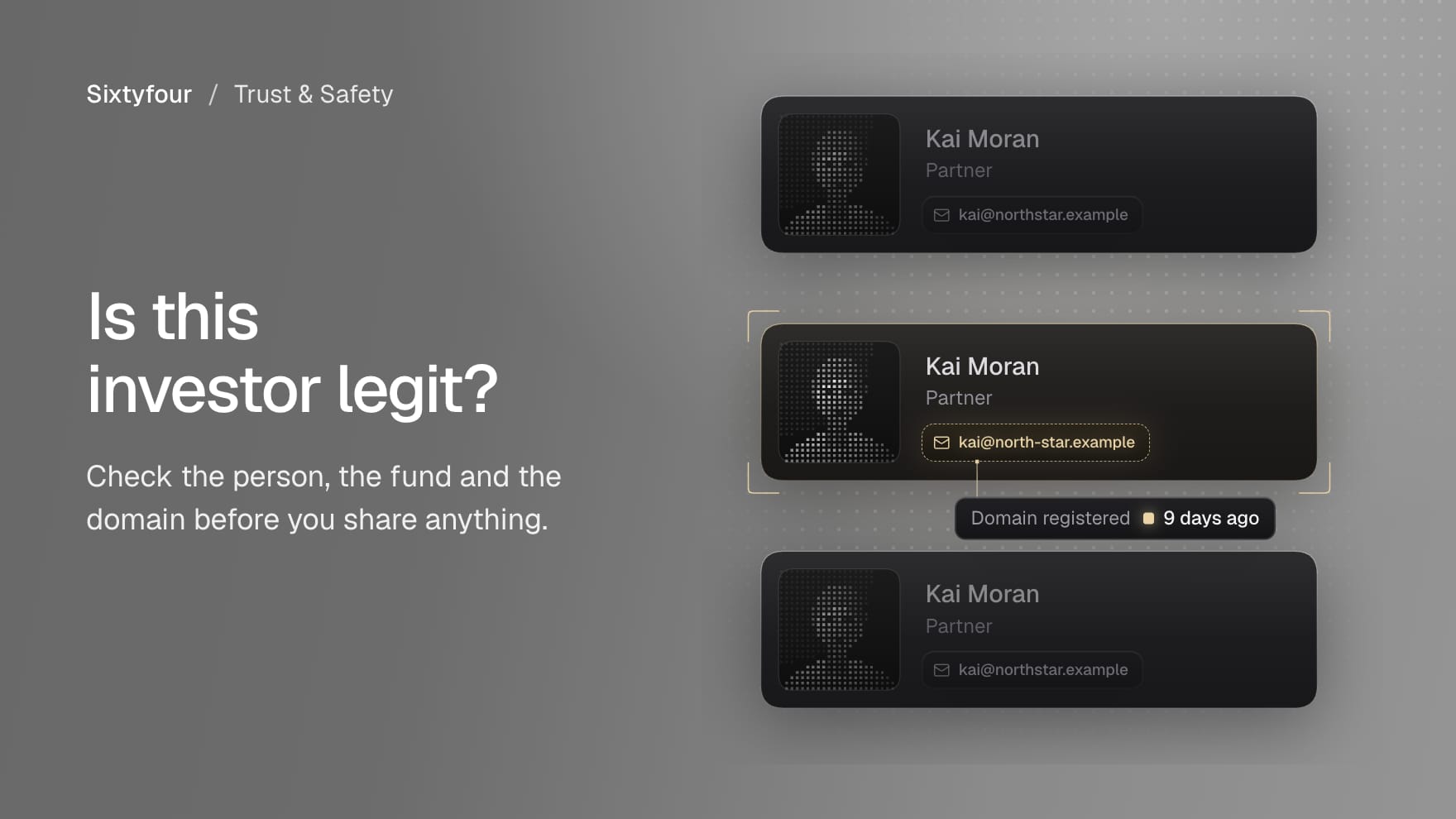
To check if an investor is legit, check four things separately, then check that they connect: the fund is real, the person works there, the email comes from the fund's own domain, and the companies they say they backed name them. Find the fund's website, team page and phone number yourself, never through the links in the message, and treat a request for a fee before any money arrives, or for special software to join a call, as the end of the conversation. Sixtyfour, our research agent, runs the research behind these checks: give it the investor's name, email address and claimed fund, and it returns where the person works today, which domains the fund uses and whether its portfolio companies name it, with the source behind each finding.
This guide is for founders approached by an investor, fund, family office or "partner" they do not know, and for anyone offered a deal by one. Our guides to doing due diligence on a person, telling if a recruiter is legit and investigating an email address go deeper on single steps.
What does a fake investor scam look like?
Public reporting shows three patterns, and one approach often combines them.
The first is a fee before any money. In a case brought by federal prosecutors in New York, a fintech chief executive collected about $380,000 in "due diligence fees" from dozens of start-ups seeking investors in 2018 and 2019, according to the Justice Department. He told them the fee was "fully refundable" and that he would assess them for investment, while he had "no interest in or financial ability to invest in any of the victim companies". When founders asked for their money back, he told them "a third-party due diligence company he had employed" had stolen the fees. He was sentenced in August 2021, for this scheme and others. In May 2024 Sifted reported speaking to seven founders caught up in one scheme in Barcelona and Milan, two of whom lost more than $200,000; in its opening case, a man presenting himself as an investment manager offered £10m in equity financing and charged a $500,000 commission in cryptocurrency.
The FBI's Internet Crime Complaint Center defines advanced fee fraud as paying money "in anticipation of receiving something of greater value in return", which describes a diligence fee for an investment that never comes. It received 7,762 complaints in its advanced fee category in 2025, with reported losses of $155.9 million, up from 7,097 complaints and $102.1 million in 2024, according to its 2025 annual report. The category covers every kind of advanced fee fraud, so these figures are not a count of fake investor scams.
The second pattern is a real firm, or a real partner, impersonated. In December 2024 the FBI and the SEC's investor education office warned of "a significant uptick" in tips, complaints and referrals about impersonations of investment professionals. Their alert, written for people being offered investments, says impersonators may use a real professional's or firm's name to open email accounts and "to register website domain names", build fake websites with the firm's logo, copy genuine information about the person, and even "Encourage investors to research the investment professional or firm they are impersonating". A 2024 FBI warning about North Korean attacks on cryptocurrency companies says the attackers' invented scenarios "often include offers of new employment or corporate investment", lists "Offers of investment from prominent companies or individuals that are unsolicited" among its indicators, and says their impersonations can involve "prominent people associated with certain technologies".
The third is a track record that is not what it seems. Portfolio logos, testimonials and filings cost little to produce. The same alert warns that "Fraudsters sometimes publish fictitious customer reviews or pay people to appear in fake testimonial videos", the FBI describes fake entities "backed by professional websites designed to make the fake entities appear legitimate", and the SEC's investor site warns that "Fraudsters may file a Form D with the SEC to give a false impression of legitimacy." What answers all three is evidence the investor did not write: the companies' own announcements, and founders you reach yourself.
How to check an investor with Sixtyfour
Sixtyfour researches what a fake investor has to fake, from what the approach gives you. Reverse Lookup takes the investor's email address and returns the person behind it, with their name, employer and profile, or "No data found" when nobody matched. People Intelligence takes the investor's name and claimed fund and researches, across sources on the web, where that person works and what role they hold. Company Intelligence takes the fund's name and the website you found yourself, returns the facts you ask for, such as the domains it uses, its investment team and the companies it has backed, and can find the people who work there.
You name each answer you want as a field, for example whether this person is a partner at this fund today. Each result lists its source URLs and what each one supports, and on the original Intelligence routes, confidence scoring gives each researched value a 0 to 100 score, a short justification and the pages it was read on. A field the agent could not establish comes back empty, and the docs say "Values are never invented to satisfy a type." Anything Sixtyfour could not establish stays open, and you decide.
Some checks stay with you: the domain's registration date, the SEC's public databases, older copies of the fund's pages in a public web archive, a call to the fund on a number from its own website, and conversations with founders it has backed. A larger decision, such as a large cheque or a board seat, can run in Atlas, where research agents build a graph that links every finding to its source, then write a report.
Is the fund real?
Find the fund yourself. Search for its name, open its website, and read its team page, its portfolio page and any page about how it contacts founders. Then date the domain. The public registration record of a domain under a generic ending includes its creation date, even where the owner's details are withheld, and ICANN's Lookup tool shows it through RDAP, which became the definitive source for that data in January 2025. A fund that says it has invested for ten years and a website registered last month do not fit.
In the US, look for the fund in the SEC's public databases. A manager's Form ADV, where it has one, can be read on the SEC's public Investment Adviser Public Disclosure site, and Part 1 of the form includes the manager's website addresses and the name of each private fund it advises. On EDGAR, the SEC's free filings database, search for the fund's name. A Form D, in the SEC's own description, includes "the names and addresses of the company's executive officers, the size of the offering and the date of first sale", so a filing by the fund can show who runs it.
Read those records both ways. A filing shows that a filing was made, which a fraudster can also arrange, as the Form D warning above says. A missing record proves little on its own. Outside the US, look up the fund's management company in its home registry: in the UK, Companies House gives some details of a company for free, including its registered address, its date of incorporation and its current and resigned officers.
Sixtyfour's part is the research across the fund's own pages and what others have written about it. Company Intelligence returns the fields you ask for, such as the domains the fund uses, its partners and its portfolio, with the source URLs behind them.
Does the person work there?
A real partner appears on the fund's own team page, in its announcements and in press coverage of its deals, and their history fits the fund's. Look for those pages yourself, and read the professional profile. A workplace verification on LinkedIn means a member "has confirmed their association with the specific company", though LinkedIn says workplace verification "is not available to all companies", so a missing badge proves little.
People Intelligence in Sixtyfour takes the name and the claimed fund and returns where the person works today and their earlier roles, with a source for each. Turn on find_people in Company Intelligence with a prompt such as "the partners and investment team" to see who Sixtyfour finds working at the fund, and compare the two.
A real name proves less than it seems. The December 2024 alert says impersonators may copy genuine information about the professional they impersonate, including their employment history, and the FBI's 2024 warning describes attackers using pictures stolen from the impersonated person's social media profiles. A real partner's name, photo and filing record can all be copied, which is why the email domain and a call to the fund's own number carry the most weight.
So reach the person through the fund. Write to them at the address on the fund's website, or call its main number and ask for them. The FBI's 2024 warning advises verifying a contact's identity "using separate unconnected communication platforms."
Does the email domain belong to the fund?
Compare the domain in the email with the one on the fund's website, one character at a time. In a 2020 warning about domains imitating its own websites, the FBI described spoofed domains as having "slightly altered characteristics of legitimate domains", such as "an alternate spelling of a word" or a different ending. Look for a dropped or doubled letter, a letter swapped for one that looks like it, an extra word such as capital, partners or ventures, and a different ending. The December 2024 alert says to be suspicious of "an email address that appears unrelated to the person's firm", and a free webmail address from someone claiming a partner's title is that case.
Then check the domain against sources the investor does not control: the fund's own website, the website addresses in its Form ADV where it has one, and any notice on its site about how its team contacts founders. Date the domain in ICANN's Lookup tool as well. Mail from a domain created last week, in the name of a fund whose own domain is ten years old, is a strong sign.
Reverse Lookup in Sixtyfour shows whether the address leads to anyone. An address with no history proves little on its own, and it counts for more when the same partner has a history on the fund's real domain and none on this one. Our guide to finding out who owns a website covers domain records in depth.
Do the portfolio companies name them?
Pick two or three companies from the portfolio the investor claims, and look for the fund in those companies' own funding announcements, on their websites and in press coverage of their rounds. If a company's own announcements name other investors and never this one, ask the investor about it.
Then talk to founders the fund has backed, reached through their companies' own websites rather than through introductions the investor arranges. Ask how the investor behaved in diligence, whether they asked for anything before the money arrived, and whether the money arrived when promised.
Sixtyfour researches the portfolio claim from both sides. Ask Company Intelligence for the fund's portfolio as a field, then run each portfolio company with a field such as "the investors named in its funding announcements", and each answer comes back with the pages behind it. A company that names the fund supports the claim. A company whose own announcements name other investors is a question to put to the investor.
If the investor will join your board or take a large stake, our guide to due diligence on a person covers company roles, court records and the person's footprint over time.
How should a first conversation with an investor go?
How the conversation runs is evidence too. Ask for a video call on the platform you normally use, an introduction to a colleague at the fund and a few days to check them, and watch for these requests:
- A fee, deposit or commission before the money arrives, for diligence, legal work, a valuation, an escrow account or processing. It was the pattern in the Justice Department case and in Sifted's reporting above, and a 2019 FBI warning about schemes built on fictitious standby letters of credit, a bank instrument used to obtain financing, lists being "asked to pay an advanced fee prior to funding" among the common features of those schemes, along with "The use of escrow accounts".
- Special software for a simple call. The FBI's 2024 list includes "Insistence on using non-standard or custom software" for tasks such as video conferencing, "Requests to run a script to enable call or video teleconference functionalities supposedly blocked due to a victim's location", and "Unsolicited contacts that contain unexpected links or attachments."
- A move off email onto a messaging app, which the FBI lists as "Requests to move professional conversations to other messaging platforms or applications", or a refusal to talk at all. The December 2024 alert says to be sceptical of anyone who refuses to speak by phone or "to meet with you over video chat or in person."
- A "proof of funds" document offered in place of money, and money that keeps not arriving. The FBI's 2019 list includes "proof of funds" documents and "Intricate explanations and excuses as to why the promised funds or returns have failed to materialize".
- Requests for your passport, your bank details, your data room or your source code before the fund itself has confirmed the investor. The FBI's 2024 warning advises companies to "Limit access to sensitive network documentation, business or product development pipelines, and company code repositories."
A worked example
The case is a composite. Tarrowmere Capital, Elias Thrandell, Odile and her company are invented, and so is every result below. Domains use the .example names reserved for documentation.
Odile runs a seed-stage freight software company and posts on LinkedIn that she is raising a $3m round. Two days later Elias Thrandell, who says he is a partner at Tarrowmere Capital, messages her there, and his next email comes from elias@tarrowmere-partners.example. He knows her product, names two of Tarrowmere's portfolio companies and offers to lead the round. On the video call his camera does not work, and he sends a link to a meeting app that asks her to install an audio update. She declines, and they finish by phone. The next day he writes that the fund will issue a term sheet once she pays a $25,000 refundable diligence fee to an outside firm, sends a copy of her passport and opens her data room.
Searching for the fund herself, Odile finds Tarrowmere's website at tarrowmere.example. Its team page lists Elias Thrandell as a partner. The domain in the email has an extra word.
She gives Sixtyfour the address, the name, the fund's name and the website she found, and asks for fields: where Elias Thrandell works today and in what role, which email domains Tarrowmere uses, who is on its investment team, how its website says the team contacts founders, and whether the two portfolio companies he named each name Tarrowmere as an investor. Confidence scoring is on.
- Reverse Lookup on the address returns "No data found".
- People Intelligence finds Elias Thrandell as a partner at Tarrowmere Capital since 2021, citing the fund's team page, a 2023 fund announcement and his own profile, with a high score.
- Company Intelligence returns
tarrowmere.exampleas the fund's only domain, citing its website, and three partners, Elias Thrandell among them. It also returns a notice on the fund's contact page saying that its team writes only fromtarrowmere.exampleaddresses and never asks founders for fees. - Company Intelligence on the two portfolio companies finds Tarrowmere named in both companies' funding announcements, citing each one.
Sixtyfour reports two things as open: nothing it found connects tarrowmere-partners.example to Tarrowmere or to anyone else, and it cannot say who sent the messages.
Odile makes her own checks. In ICANN's Lookup tool, Tarrowmere's domain was created in 2015 and the lookalike nine days before the first message, with its owner's details withheld. On the SEC's Investment Adviser Public Disclosure site, the Form ADV of Tarrowmere's management company lists tarrowmere.example as its website. She writes to Elias at the address on the team page and calls the main number on the fund's website, and the fund's operations lead confirms that nobody at Tarrowmere contacted her and that Elias's name has been used before.
So the fund is real, the partner is real and the portfolio names the fund, and the person writing to her is someone else. The fee and the software were reasons enough to stop, and the domain and the call settled it. Who registered the lookalike stays open. Odile sends nothing, keeps the emails, reports the profile to LinkedIn and the messages to the FBI's Internet Crime Complaint Center, and tells Tarrowmere, which adds the lookalike domain to the notice on its website. Sixtyfour found and cited the facts, and the decisions stayed with Odile.
What each check shows
| Check | What a strong result shows | What it cannot show |
|---|---|---|
| The fund's website and team page, found yourself | The fund exists and lists this person | That the person writing to you is them |
| The email is on the domain from the fund's own website | The usual sign of a real fund address | That the mailbox has not been taken over |
| A lookalike domain, or one created weeks ago | The message did not come from the fund's domain | Who registered it |
| A Form ADV or Form D that names the fund and its people | A filing exists with these names and addresses | That the filer is honest, or that the writer is in it |
| No SEC record | Little on its own | That the fund is fake |
| Portfolio companies name the fund in their own announcements | The fund made those investments | That this person works there |
| Founders the fund backed, reached yourself | How the fund behaves with the companies it backs | Anything about an impostor using its name |
| A call to the fund's main number from its website | Whether the fund knows about this approach | Much, when the number came from the message |
| A request for a fee or special software before any money | The approach matches the scams described above | Who is behind it |
What defeats these checks
- A real partner's mailbox or profile in the wrong hands. The domain and profile checks pass, and the requests themselves and a call to the fund's own number are what catch it.
- A convincing face or voice on a call. The December 2024 alert says impersonators may disguise themselves with AI-generated content, "including cloned voices, altered images, and deepfake videos", and that "fraudsters may go so far as to impersonate an investment professional on the phone, over video chat, or in person." A call you place to the fund's own number is much harder to fake than a call you receive.
- A fund built from scratch, with its own website, profiles and even a filing. With no real fund to compare against, look for a history other people wrote over the years: founders it backed, press about its deals, its partners' earlier careers.
- Time pressure. A term sheet that expires before your checks finish is part of the method, and a real investor can wait a few days.
Reading the evidence fairly
An investor who fails one check may still be real, because several things that look wrong have ordinary explanations.
- Angel investors and family offices may have no website or team page, and a search of the SEC's databases may find nothing under their names. Ask for founders they have backed, and confirm those through the companies' own websites.
- A new fund has a thin footprint, so check its first-time manager's own career instead.
- Scouts, venture partners and advisers may not appear on a fund's team page. Ask the fund through its own contact details.
- A partner writing from a personal address is a reason to confirm through the fund, and proves nothing on its own.
- A company may not announce every investor, especially a small cheque, so a missing name in an announcement is a question to ask.
- A search that finds nothing about a person, or a lookup that returns "No data found", is a gap in the evidence.
Act on what fails against the fund's own records, reached through channels you chose: a domain the fund does not use, a partner it says never contacted you, or a request for money before any money arrives.
The short version
Check the fund, the person, the email domain and the portfolio separately, through the fund's own website and phone line and founders you reach yourself, and make sure the four connect. Treat a request for a fee before any money arrives, or for special software to join a call, as the end of the conversation. Sixtyfour runs the research behind these checks from the investor's name, email address and claimed fund, and returns where the person works, whether the domain is the fund's and whether its portfolio names it, with a source behind every finding.