
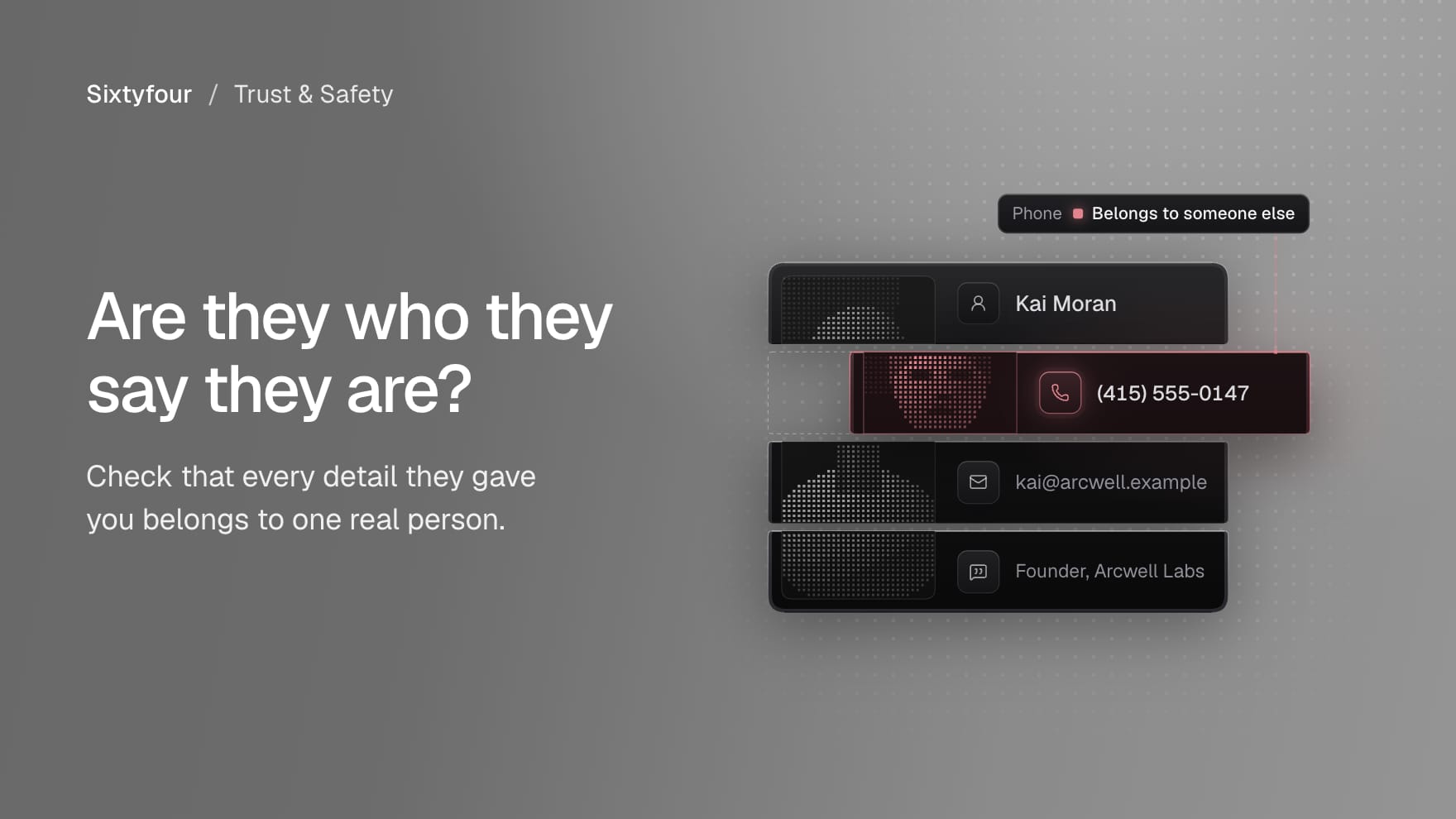
To check if someone is who they say they are, write down every detail they have given you, then test whether those details belong to one real person. Their name, photo, phone number and email address should all lead to the same person, that person should appear on pages they do not control, their history online should be as old as their story, and none of the details should turn up under another name. Confirm anything that matters through a channel you found yourself, and stop if they ask for money or documents before you have met. Sixtyfour, our research agent, runs much of this research: give it the name, email address, phone number and any profile links you were sent, and it returns who each detail leads to, with source URLs for the fields it researches.
This guide is for anyone dealing with someone they have only met online, such as a buyer or seller, a landlord or tenant, a contractor, or a new contact asking for money or access, and for trust and safety teams checking the people on their own platforms. Our guides to finding out who is behind a fake account and telling if a LinkedIn profile is fake cover attributing an anonymous account and checking one profile in depth.
What does checking someone's identity involve?
The US National Institute of Standards and Technology describes identity proofing, in its digital identity guidelines, as making sure that a person "is who they claim to be to a stated level of confidence". It divides the work into three steps: resolution, which works out whether the claimed identity is one real person; validation, which confirms that the evidence is authentic and accurate; and verification, which confirms that the person presenting the evidence is "the same individual to whom the evidence was issued."
From outside, with no documents and no access to a platform's records, you can do a great deal of the first step: show that the details you were given describe one real person, and find anything that contradicts the story. Validating a document and matching a live face to it are a separate layer, offered by identity verification services and built into some platforms' sign-up checks.
The FBI's Internet Crime Complaint Center received 23,159 complaints in its confidence and romance fraud category in 2025, which covers people tricked into sending money or information by someone they believe is a relative, friend or partner. Reported losses were $929.3 million, up from 17,910 complaints and $672.0 million in 2024, according to its 2025 annual report, which adds that scammers "are creating fake profiles and scripts produced by AI chat generators".
How to check if someone is who they say they are with Sixtyfour
Sixtyfour researches the details you were given and reports who each one leads to. Reverse Lookup finds "the person behind an email address or phone number", with their name, employer and profile, and returns "No data found" when nobody matched. People Intelligence takes what you know about the person, such as a name, an email address, a phone number, a username or a profile link, researches them across sources on the web, and returns the fields you ask for: where the person lives and works today, for example, which pages other than their own profiles mention them, or whether a phone number or email address appears with them anywhere. Each result lists its source URLs and what each one supports.
On Sixtyfour's original Intelligence routes you can also turn on confidence scoring: every value then comes back with a 0 to 100 score, a short justification and the pages it was read on. The docs say each score reflects "how much assumption is needed to tie the value back to the target person", and that "a low score means attribution is uncertain". Verify Email checks whether an address can receive mail. On the high and xhigh research tiers, which are enabled on request, you can also ask for a recent photo of the person as a field and compare it yourself with the one you were sent. Sixtyfour does not examine identity documents or verify selfies.
Teams that review many accounts can research them in one job through Bulk Intelligence, and Lattice, in beta, turns their rows into one graph in which accounts that share an email address, phone number or profile URL connect. Larger cases can run in Atlas, enabled on request like Lattice, which builds an attribution graph that links each finding to its source. A field Sixtyfour could not establish comes back empty, and you decide. Some checks stay with you: reverse image searches, the dates platforms show, website registration dates, property records, a call or video through a channel you chose, and any document check. Our trust and safety page has more on how platform teams use it.
What details should you write down first?
Before you check anything, write down every detail the person has given you and where you saw it, because each one is a separate claim you can test.
- Every name and photo they use, including display names, nicknames, the name on any payment request and photos sent privately.
- Phone numbers and email addresses.
- Usernames, and links to profiles, websites or listings.
- Where they say they live and work, and who they say they work for.
- The story and its dates: how long they have owned the flat, run the business or lived in the city.
- What they are asking you for, and how they want to be paid.
Save each message and profile with the date you saw it, since accounts and listings can disappear, and keep what they told you apart from what you find yourself.
Do the name, photo, phone and email belong to the same person?
Each detail should lead to the same person on its own. A name, a face, a phone number and an email address can each be real and still belong to four different people. That is what a borrowed identity looks like from the outside.
Start with the phone number and the email address. Sixtyfour's Reverse Lookup returns the person behind each one, or no match. A result with the same name, in the same city or at the same employer, supports the story, and a different name is a question to resolve. No match counts for little on its own, since new numbers and private addresses are common, and numbers change hands: Princeton researchers who studied number recycling note that "after a while, carriers reassign them to new subscribers", so an old record may belong to an earlier holder. Verify Email shows whether an address can receive mail, which says nothing about who reads it.
Then the photo. Run every image through a reverse image search yourself. Google's search by image can return "Websites with the image or a similar image", and its About this image panel, available in some regions, can show "When Google may have first seen a similar version of the image." The FTC's advice on romance scams is to check whether a profile picture is "associated with another name or with details that don't match up", which it calls signs of a scam. A match under another name counts only on pages older than the profile, because on newer pages the copying may run the other way. A match under the same name shows only that the photo is that person's, which an impostor would also want.
A photo that matches nothing settles nothing. In a 2022 study, researchers at Lancaster University and the University of California, Berkeley found that people asked to tell real faces from AI-generated ones were right 48.2 percent of the time, close to chance, and 59.0 percent with training and feedback. A face that appears nowhere else may be a private person's photo or a generated one, and looking harder at it will not tell you which.
In Sixtyfour, ask for each link as a field, for example whether this phone number belongs to this person, and with confidence scoring on, the score and its justification show how firmly the evidence ties the two together.
Does the person exist outside their own profiles?
A real person usually appears on pages other people wrote: an employer's team page, a club, a conference programme, local news, or the records their story would leave behind. Their own profiles count for less, because anyone can write one. The FTC's advice on rental scams is to search for the name of a property owner or rental company with the words "complaint," "review," or "scam," and, with a private landlord, to search "city or county tax assessment websites to learn who owns a property".
Sixtyfour carries out this search from the name and whatever else you have, such as an employer, a city or a profile link, and reports where it found the person, with each page cited. A field it could not establish comes back empty.
Then check that the history is as old as the story. Someone who says they have run a business for ten years, or lived in a city since 2015, should have traces from those years. Several platforms show their own dates. Instagram's About this account gives the date joined, "the date the account was created", and how many times the username has changed. LinkedIn introduced a panel in 2022 to "show you when a profile was created and last updated", which its help pages now call About this member. For a website the person says is theirs, the public registration record of a domain under a generic ending includes its creation date, which ICANN's Lookup tool shows. The Internet Archive's Wayback Machine lets you search archived pages by address and date range, though not every site was captured. These dates are checks you make yourself.
Are the same details being used under another name?
The last test turns the question around: look for each detail attached to someone else. A photo on older pages under another name, a phone number or email address that Reverse Lookup ties to a different person, or a listing that appears elsewhere with another owner all suggest the details were borrowed. The FTC says that if other ads for the same rental address come up "with a different owner or rental company name, that's a sign of a scam."
Platforms have a second source: their own records. A phone number, email address or photo that appears on several accounts under different names is a reason to review those accounts together. Lattice makes that connection across a team's own rows: an email, phone, profile URL or domain "that appears in several rows becomes one entity, so those rows connect through it", and the docs say it "never merges people on name alone". Each shared value still needs weighing by how many unrelated people could share it, which our guides to linking related accounts and identity resolution explain.
When should you ask for a call, a video or an ID?
Ask for confirmation through a channel you found yourself, never one the person gave you. The FBI's warning about generative AI fraud advises verifying a caller "by hanging up the phone, researching the contact of the bank or organization purporting to call you, and call the phone number directly." If someone says they work for a company, call the company's main number from its own website and ask for them.
A video call adds evidence, and it proves less than it used to. The same warning says criminals "generate videos for real time video chats" in which they pose as executives or officials, and create videos meant to "prove" the online contact is a "real person." It suggests looking for imperfections such as "lag time" and "unrealistic movements", and agreeing "a secret word or phrase" with your family to verify their identity.
Treat a photo of an identity document sent in a message as a picture. The FBI warns that criminals "generate fraudulent identification documents, such as fake driver's licenses", so an image shows only that someone has one. Checking a document properly means confirming, in NIST's words, that it is "authentic (i.e., not forged or altered)" and that the person presenting it is the one it was issued to, which identity verification services and platforms' sign-up checks are built for. For a private landlord, the FTC suggests checking their ID against the property records. Sixtyfour's research sits beside that layer: it tests whether the other details you were given belong to the person the document names.
What are the signs that it is a scam?
Identity checks matter most when someone wants something from you, and the same requests recur in the FTC's and the FBI's advice.
- They cannot meet. The FTC says romance scammers "say they can't meet you in person", claiming to be outside the country, on an oil rig, in the military or with an international organisation, and that a fake owner of a rental "will usually claim to be out of the country".
- They ask for money, or for help with a cost: medical bills, travel, a visa, a deposit or an application fee.
- They tell you how to pay: by wire transfer, gift cards, a money transfer app or cryptocurrency. The FTC says paying by wire transfer, gift card or cryptocurrency is "like sending cash".
- They hurry you. On rentals, the FTC's advice is "If anyone pressures you to make a decision quickly, walk away."
- They ask for your ID or bank details before you have met. The FBI says "Never share sensitive information with people you have met only online or over the phone."
The FTC's bottom line on romance scams is "Never send money or gifts to a sweetheart you haven't met in person", and the FBI gives the same advice about anyone you have met only online or over the phone.
A worked example
The case is a composite. Gormanby, Gessenford Partners and Callum Gelvarry are invented, the domains use the .example names reserved for documentation, and the phone number comes from the fictitious 555-0100 to 555-0199 range.
Hana is moving to Chicago and finds a one-bedroom flat on Gormanby, a home rentals marketplace, at a rent well below others nearby. The host, Callum Gelvarry, says he is a structural engineer at Gessenford Partners who has owned the flat since 2016 and is on a contract in Singapore, so he cannot show it. He asks her to pay the first month's rent and a deposit by bank transfer, outside the platform, to hold it until the weekend. His profile gives callum.gelvarry.lets@mailbox.example and +1 312 555 0167. When Hana asks for a video call he says the time difference makes it hard, and sends a photo of a driving licence instead. She pays nothing and reports the listing.
Imogen, an analyst on Gormanby's trust and safety team, writes down every detail, from the name and photo to the story's dates and the licence photo. Gormanby's own records show the account joined 19 days earlier.
She gives Sixtyfour the name, the employer, the email address and the phone number, and asks for fields: where Callum Gelvarry lives and works today, which pages other than his own profiles mention him, and whether anything ties him to the email address, the phone number or a property in Chicago. Confidence scoring is on.
- Reverse Lookup returns "No data found" for the email address and for the phone number.
- People Intelligence finds a Callum Gelvarry who has been a structural engineer at Gessenford Partners in Leeds since 2017, citing the firm's team page at
gessenford.example, his professional profile and a 2022 conference programme, and gives the employment field a high score with a justification naming those pages. It finds nothing tying him to Chicago, the email address or the phone number, and those fields come back empty. - Gormanby runs each week's new host accounts from its own records through a workflow into a Lattice graph. In those records the same phone number is listed on two other host accounts, created the same week under two other names, each listing a flat in a different part of the city, so the graph connects all three.
Imogen makes her own checks. A reverse image search finds the profile photo on a dental clinic's staff page in another country, under a different name, since 2021, and the licence photo carries the same face. The county's property tax website lists a different owner for the flat's address. She writes to Callum Gelvarry at the address on Gessenford's website, and he replies that he has never owned property in Chicago and has no Gormanby account.
So the name belongs to a real engineer in Leeds, the face belongs to someone else under another name, the phone number ties three new accounts with three names together, and the flat has another owner. Who runs the accounts stays open. Gormanby removes the three listings, warns the guests who messaged them not to pay, and tells Callum Gelvarry and the clinic that his name and their colleague's photo are being used. Sixtyfour ran the research and cited what it found. The platform's records and Imogen's own checks covered the rest, and the decisions stayed with the team.
What each check shows
| Check | What a strong result shows | What it cannot show |
|---|---|---|
| The phone number or email address leads to the same name | Someone of that name has used the detail | That they are the one writing to you |
| No match for the phone number or email address | Nothing on its own | That the person is not real |
| The photo appears under the same name on older pages | The photo is that person's | That the person sending it is them |
| The photo appears under another name on older pages | The profile is very likely using someone else's photo | Who is behind it |
| No match for the photo | Nothing either way | Whether the face is real or generated |
| Pages other people wrote about the person, over years | The person exists and has the history they describe | That this is the person contacting you |
| An account or website much newer than the story | The online history does not match the story | That the person is invented |
| A phone number or email address shared by accounts under other names | The accounts are probably connected and worth reviewing together | Which name, if any, is real |
| A video call or a photo of an ID | A face that matches, or an image of a document | That the video is live or the document genuine |
| A request for money or documents before you have met | The pattern of a scam | Who is behind it |
What defeats these checks
- A real identity in the wrong hands. If someone controls a real person's account, email address or phone, the details agree because they are that person's, and a call through a channel you found yourself is what catches it.
- A complete borrowed identity, where the name, photo and history all belong to one real person. The first checks pass, and the phone number, the email address and a confirmation through the person's own employer or contacts are what fail.
- A real person telling a false story. Identity checks show who someone is and say little about whether the flat, the job or the deal exists, so check the thing itself as well.
- Generated faces and video, which leave nothing for an image search to find and can hold up on a call.
- Pressure. A deadline that runs out before your checks do is part of the method, and a genuine person can wait a day.
The checks that hold up best are the ones the person does not control: records other people wrote over the years, and a channel you found yourself.
Reading the evidence fairly
Most people who fail one check are who they say they are, and a fair review looks for the ordinary explanation first.
- A small footprint is common. People who are private, older, newly arrived or off social media leave few pages, and a search that finds nothing is a gap in the evidence.
- Names vary, through marriage, nicknames and transliteration, and common names are hard to pin down. Sixtyfour's docs note that with a very common name "even well-sourced fields score lower because the identity link is uncertain".
- Numbers and addresses change hands, and families share them.
- New accounts are ordinary. People join platforms late, and start again after a hack or a break-up.
- Photos are often old or edited, and a real person whose photo turns up under another name is usually a victim.
- Landlords use agents and contractors work through firms, so find out who the agent or firm is before treating a mismatch as a lie.
Act on contradictions you confirmed through records the person does not control, and on requests a genuine person has no need to make.
The short version
Write down every detail you were given, then check that the name, photo, phone number and email address lead to one person, that the person appears on pages they do not control with a history as old as their story, and that none of the details turns up under another name. Confirm through a channel you found yourself, and treat a request for money or documents before you have met as the end of the conversation. Sixtyfour runs the research behind these checks from the details you were given and returns who each one leads to, with the sources for what it found.