
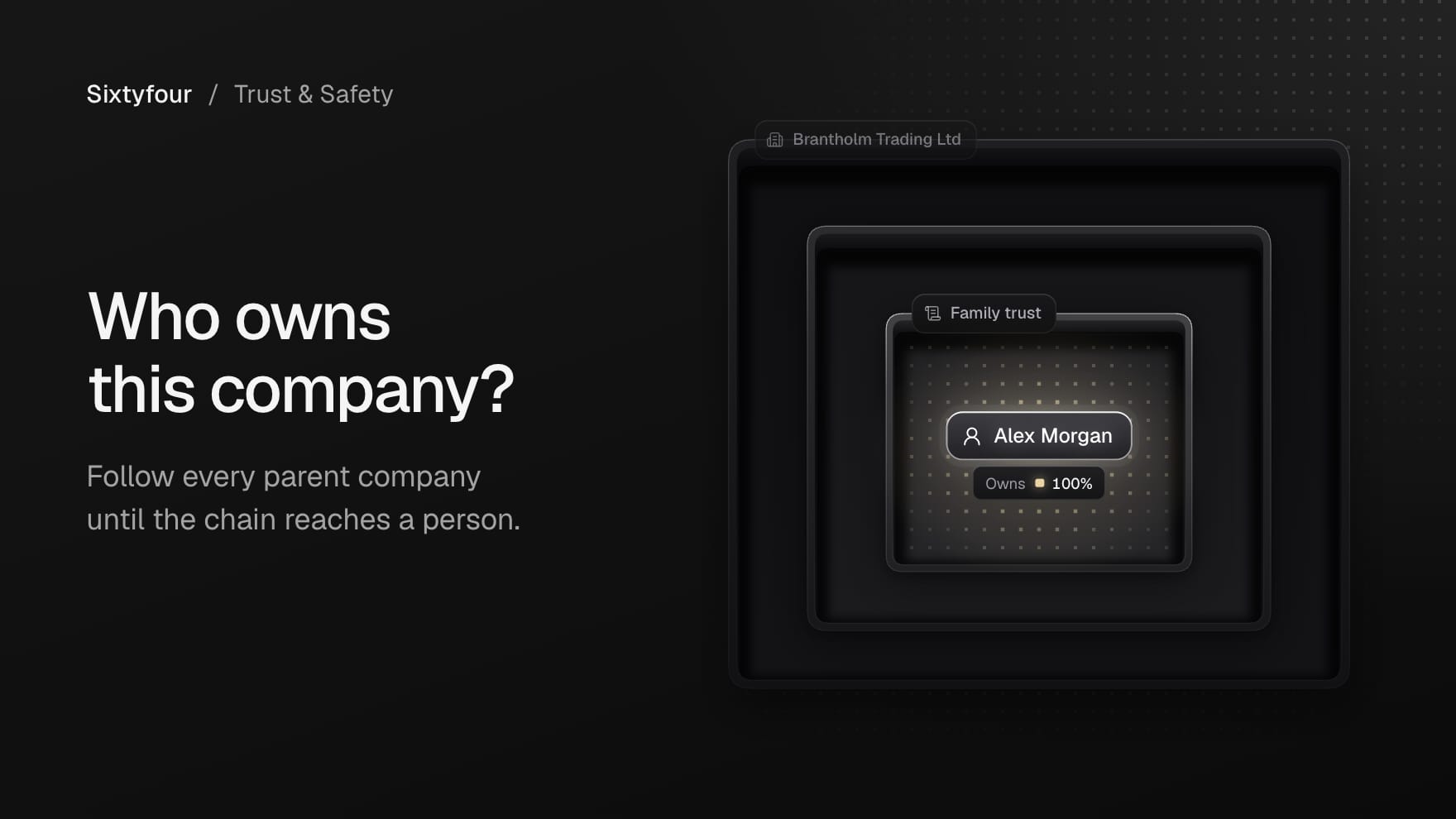
To find out who owns a company, start with the registry where it was formed and read what it has filed, then follow the names: shareholders or members for the legal owners and, through any parent company, the beneficial owner, the person who ultimately owns or controls it. For a US public company, its annual report, proxy statement and the SEC's beneficial ownership reports name its directors, officers and largest holders, and in the UK, Companies House publishes each company's people with significant control for free. Sixtyfour, our research agent, does this research from a company's name or website and returns the officers, owners and parent companies it finds, each with its source.
A name on a filing is more often a director or a registered agent than an owner, and the owner can sit one or more companies further up. Our guides to finding out who owns an LLC, shell company red flags and doing due diligence on a person go deeper on single steps.
Ownership has layers, and each one shows up in a different record.
- Shareholders own a company limited by shares. The UK government's guide to setting up a company says "A company limited by shares must have at least one shareholder, who can be a director." In an LLC, the IRS says, "Owners of an LLC are called members."
- Directors oversee the company. The SEC's investor education site defines a board of directors as "A group of people elected by shareholders to oversee the management of a corporation." Holding shares is a separate role, though one person can hold both: Texas's secretary of state notes that "A single person can be the president, secretary, sole director, and sole shareholder."
- Officers, such as a president and a secretary, appear beside the directors in the management records Texas publishes, and they often sign the company's documents.
- The registered agent receives legal papers on the company's behalf, and many agents are businesses that provide the service to other companies, as Delaware's list of registered agents shows.
- The beneficial owner is the person at the end of the chain. The Puppet Masters, a 2011 study by the World Bank and UNODC's Stolen Asset Recovery Initiative, defines the beneficial owner as "The natural person who ultimately owns or controls the corporate vehicle or benefits from its assets", and notes that "a legal person cannot, by definition, be a beneficial owner."
Ownership and control can come apart. The same study puts control at the centre of beneficial ownership and observes that control and legal title "often will lie in the same hands", though in the situations the report addresses they often do not. The UK register draws its line at 25 percent: the government's guide says a shareholder with more than 25 percent of the shares or voting rights "is classed as a person with significant control".
How to find out who owns a company with Sixtyfour
Give Sixtyfour a company's name or website and the fields you want back, such as its officers and directors, its parent company and the natural persons who ultimately own or control it, and Company Intelligence researches the company and returns each field with the sources it was read on. Its deepest tier, available on request, runs what the docs call "deep, recursive research across the open web, public records, directories and specialist sources". A research plan in plain language tells it where and how to look, for example to follow each parent company until it reaches a person, and it can find the people at the company and return the fields you ask for on each. With confidence scoring on, every field carries a 0 to 100 score, a short justification and its source URLs. In the docs' words, "A high score means the evidence chain is strong; a low score means attribution is uncertain."
For each person it finds, People Intelligence researches the fields you ask for, such as their roles at other companies, again with sources. Anything Sixtyfour could not establish, such as the size of a holding that no record states, comes back as open, and a person on your team decides. Asking the company for its own ownership chart stays with your team too.
Analysts who need the whole chain in one place run it in Atlas, enabled on request, where research agents build a workspace and an attribution graph that links every finding to its source, then write a report. Teams that check many companies call Company Intelligence through the Research API. Lattice, in beta, turns rows of people and companies into one connected graph, so an email address, phone number or domain shared by several rows connects them. There is more on how financial crime teams use Sixtyfour on our financial crime page.
How do you find out who owns a public company?
A US public company's ownership is in its SEC filings, which anyone can read on EDGAR. Three kinds of filing carry most of it.
- The annual report on Form 10-K. Its Item 12, "Security Ownership of Certain Beneficial Owners and Management and Related Stockholder Matters", gives "information about the shares owned by the company's directors, officers and certain large shareholders", according to the SEC's investor bulletin How to Read a 10-K/10-Q. Most companies give it in the proxy statement for their annual meeting instead, which the bulletin says "is typically filed a month or two after the 10-K."
- Schedules 13D and 13G. The SEC's investor education site calls them "beneficial ownership reports", and they show a person or group holding more than 5 percent of a voting class of a company's shares. Its description of a beneficial owner "includes any person who directly or indirectly shares voting power or investment power".
- Forms 3, 4 and 5. These report the holdings and trades of a company's officers, directors and anyone holding more than 10 percent of a class of its securities.
Sixtyfour carries out this step from the company's name, and each holder it returns comes with the URL it was read on. A large holder is often a fund or another company, which is a new search. Public companies from outside the US usually file their annual reports with the SEC on different forms, the bulletin notes, so look for those under the company's name.
To find the parent of a company that belongs to a listed group, search its name in EDGAR's full-text search, which covers "all EDGAR filings submitted electronically since 2001", attachments such as exhibits included. The exhibits to a 10-K include, in the bulletin's words, "a list of the company's subsidiaries".
How do you find out who owns a private company in the US?
Start with the registry of the state where it was formed, usually the secretary of state. The National Association of Secretaries of State links to each state's business registration pages and name databases. What a registry shows varies, and it may say nothing about shareholders.
- Delaware's free entity search gives "the entity name, file number, incorporation/formation date, registered agent name, address, phone number and residency", and more costs a fee.
- Texas collects a corporation's officers and directors on the Public Information Report filed with its yearly franchise tax report, and the Comptroller shows them in its online Taxable Entity Search, from the most recent report. Its secretary of state's FAQ says it "does not maintain any information on a corporation's shareholders, with the limited exception of a close corporation", and that its management records are "not necessarily current".
Read the filings themselves, note who signed each and the title they gave, and check every state where the company is registered to do business. The Texas report's form also asks for each corporation, LLC or other entity "that owns an interest of 10 percent or more" in the company, so the company's own copy of its latest report is a reasonable document to ask for.
Where the registry stops, look where the company signs things and raises money. County recorders index deeds and mortgages by the parties' names: Cook County's recordings division says its records "can be retrieved by searching for PIN, grantor, grantee, and by other indexed detail". A lender's financing statement gives the "debtor/secured party name and address", in the words of California's UCC FAQs. A company that raised money in certain private offerings may have filed a Form D, whose related persons section names "Each executive officer and director" and any promoters. These records show who signs for the company, who lends to it and who runs it, which is not always who owns it. Sixtyfour researches the company from its name and returns each field with the URL it was read on, so you can open the record behind it. The request to the company for its shareholder list stays with your team.
How do you find the owner of a business that trades under another name?
A shop, practice or contractor often trades under a name that is not its legal name. The Small Business Administration's example is an owner who "could use Springfield Electronic Accessories for their entity name but use TechBuddy for their DBA." Assumed-name or fictitious business name filings tie the two together.
Los Angeles County's statement lists every owner of a trading name with their residence address, and asks for a corporate officer's signature when the owner is a corporation. So for a sole trader the statement names the person, and for a company it names the company, which you then look up in the state registry. Give Sixtyfour the trading name and ask for the legal business behind it, and it returns what it finds with its sources, or reports the link as open. Our guide to finding out who owns a website covers tying a site to the business behind it.
How do you find out who owns a company in the UK?
Companies House's Find and update company information service "makes all of the public data we hold on companies available free of charge", and the same data is available through an API. For each company it shows the current and resigned officers, the filing history with images of the documents, and the register of people with significant control (PSCs).
The PSC register is the closest thing to an ownership answer. Most of a PSC's details are public, apart from their home address and full date of birth, Companies House says, and include how they control the company. The Companies House API's own descriptions of those natures of control run in bands: more than 25 percent and up to 50 percent of the shares, more than 50 and up to 75, and more than 75, with the same bands for voting rights, plus the right "to appoint or remove a majority of the board of directors of the company" and "significant influence or control over the company".
When you read it:
- A PSC can be a company. The API returns a corporate entity with significant control as its own kind of entry, and that company is the next layer to search.
- The bands are wide, and holders of 25 percent or less do not appear unless they control the company in another way. Two PSCs in the "more than 50" and "more than 25" bands can leave just under a quarter of the shares unaccounted for. A confirmation statement can record changes to "shareholder information" and the "statement of capital", so the filing history may show shareholders the register leaves out.
- Where the company names no one, the register carries a statement instead, such as that the company believes "there is no registrable person or registrable relevant legal entity in relation to the company". Some entries are withheld because "restrictions on disclosing any of the individual's details are in force".
Each director's name, nationality and month and year of birth are public too, which helps separate two people with the same name. Ask Sixtyfour for a UK company's directors and PSCs, and each comes back with the URL it was read on, to check against the register. Read every entry as what the company told Companies House on that date: the guidance says "a close review of each document during registration is not always possible."
How do you follow a company owned by another company?
Find where the parent was formed, read its registry entry and filings there, and record each link with its source: the record that ties the child to the parent, and the record that names the parent's own owners. Each parent is a new search, and the chain ends at a person or at a record that names no one. Write down which. With that instruction in its research plan, Sixtyfour looks for each parent the same way and reports a layer it could not trace to a person as open.
Three sources help when the chain crosses a border.
- Legal Entity Identifier records. The Global Legal Entity Identifier Foundation publishes free the "direct accounting consolidating parent" and "ultimate accounting consolidating parent" that entities with an LEI report. An entity can give a reason instead of a parent, and one listed reason is that it "is controlled by a natural person(s) without any intermediate legal entity". These are accounting parents, and only for entities that hold an LEI.
- The parent's own registry. If the parent is foreign, its home registry decides how far you get.
- The ICIJ's Offshore Leaks database, which covers "more than 810,000 offshore entities" in records up to 2020. The ICIJ adds that "There are legitimate uses for offshore companies and trusts" and that "Many people and entities have the same or similar names."
Some links are stronger than others. A person who sits on both layers, such as an officer of the child who is also a director of the parent, links them through records each company filed. The child's own statement that it belongs to the parent, with an independent article or filing that agrees, is a second link. A registered agent's address shared by both is not a link on its own, because one agent serves many companies.
A worked example
The case is a composite. Tavencroft Machining, Thrupwell Holdings, Daniel Trelaskin and Grace Tennerby are invented, and the domain uses the .example name reserved for documentation.
An equipment finance company is reviewing an application from Tavencroft Machining Inc., a Texas machine shop, to finance two machining centres for about $1.4 million. The application names Daniel Trelaskin as president, gives the website tavencroft.example, and says the company is wholly owned by Thrupwell Holdings Ltd, a UK company. Before the credit committee meets, the analyst wants to know who stands behind both.
The analyst runs Sixtyfour's Company Intelligence at its deepest tier on the company's name and website, with confidence scoring on, and asks for four fields: officers and directors, parent company, the parent's share of Tavencroft, and the natural persons who ultimately own or control it, with any ownership band a register states. The research plan tells it to follow each parent until it reaches a person. Sixtyfour returns each field with its sources.
- Officers and directors: Daniel Trelaskin as president and director, and Grace Tennerby as a director, from the officer and director list the Texas Comptroller's Taxable Entity Search shows from Tavencroft's 2026 Public Information Report. High score, with the justification noting that the record is only as current as the last report.
- Parent company: Thrupwell Holdings Ltd, from two sources that agree, Tavencroft's own website, which calls it "a Thrupwell company", and a 2023 trade press article reporting that Thrupwell bought the shop. High score, and the justification adds that both Texas directors are also Thrupwell's directors.
- Natural persons: from Thrupwell's Companies House record, two PSCs: Trelaskin, an American, with more than 50 and up to 75 percent of the shares and voting rights, and Tennerby, who is British, with more than 25 and up to 50 percent. Its last confirmation statement is dated March 2026. High score as Thrupwell's PSCs, and the justification notes that they stand behind Tavencroft only through Thrupwell's holding, the open field below.
- The parent's share of Tavencroft: open. The Texas secretary of state keeps no shareholder information, and no record Sixtyfour found states what Thrupwell holds, so "wholly owned" rests on the application alone.
People Intelligence on each person adds a 2019 business journal interview describing Trelaskin as the shop's founder, a professional profile listing both his roles since 2023, and a 2023 announcement on Thrupwell's website naming Tennerby as a co-founder, each with its source. Because the loan goes to committee, the analyst also runs the case in Atlas, which keeps every finding in an attribution graph and writes the report that goes into the credit file.
Three things stay open, and the file says so: whether Thrupwell owns all of Tavencroft, who holds the share of Thrupwell that the PSC bands leave room for, and whether anything has changed since March 2026. The analyst asks Tavencroft for its share register and an ownership chart for Thrupwell, signed by an officer. The reply shows Thrupwell holding all of Tavencroft, and Thrupwell's shares split 60 percent to Trelaskin, 32 percent to Tennerby and 8 percent to an engineer who joined in 2024. That fits the PSC bands, and the file records the chart as the company's own statement. Sixtyfour found the records and scored each field, and the credit decision stayed with the committee.
What each record shows
| Record | What a strong result shows | What it cannot show |
|---|---|---|
| Registry search result | The company was formed, when, and who its registered agent is | Who owns or runs it |
| State officer and director records, such as Texas's | Who ran it as of the last report | Its shareholders, or changes since the report |
| 10-K Item 12 or proxy statement | Shares held by directors, officers and large holders on a stated date | Who stands behind a fund or company holder |
| Schedule 13D or 13G | A person or group with more than 5% of a voting class | Holders below that line |
| Forms 3, 4 and 5 | Insiders' holdings and trades | Holders who are not insiders |
| Form D related persons | The executive officers, directors and promoters | Who holds the shares |
| UK PSC register | People or companies with significant control, in bands | Holders at or below 25%, or arrangements nobody filed |
| UK officers list | Directors and secretaries, with month and year of birth | Their shareholdings |
| LEI parent records | The accounting parent the entity reports | People, or parents with no LEI |
| Deeds and financing statements | The company as a party, and who signed for it | Whether the signer owns it |
| Assumed-name statement | The owner of a trading name, a person or a company | Who stands behind a company owner |
| The company's own chart or statement | What the company says about itself | Anything it leaves out |
Two records count as two only if neither was copied from the other.
What defeats these checks
- Nominees. The Puppet Masters describes a nominee shareholder who holds all of a company's shares on paper "only on behalf of the beneficial owner", and a Nevada company set up with a nominee director and nominee shareholders where "The name of the beneficial owner appears nowhere on the incorporation documents."
- Layers in places whose registries publish little. A chain that passes through a registry showing only an agent stops there, and has to be recorded as a dead end.
- Holdings spread below the reporting lines. Several holders who each stay under the 5 percent line for Schedules 13D and 13G, and do not report as a group, or under the 25 percent line on the UK register, leave no single holder on either record.
- Stale records. Texas's management records are "not necessarily current", and a PSC entry is as current as the company's last update.
- Control by agreement or through a trust. The UK register has entries for control through a trust, and no public record shows an arrangement that nobody filed.
Reading the evidence fairly
Most layered ownership is ordinary, so a fair review checks the ordinary explanation first.
- Holding companies are a normal part of business. The Puppet Masters says companies without operations of their own "are commonly formed to serve a variety of legitimate economic functions", including serving "as a personal holding company".
- A director who owns nothing is normal, and so is an owner who runs nothing.
- Names collide. Treat a match between two records as a link only when a second detail agrees, such as a month and year of birth or a role on both layers.
Keep the levels apart. A thin record is a reason to look further, a name that appears on two layers is a link to confirm, and two independent records that agree, or the company's own signed statement, settle what they cover. The file records what they leave open.
The short version
Read the registry where the company was formed and every filing it made, then follow the names: shareholders or members for the legal owners, SEC filings for a public company's large holders, and the PSC register for a UK company. Treat each parent as a new search until the chain reaches a person or a record that names no one, and count a link only when two independent records agree. Sixtyfour runs this research from a company's name or website and returns each officer, parent and owner with its source and a confidence score, so your team decides from evidence it can check.