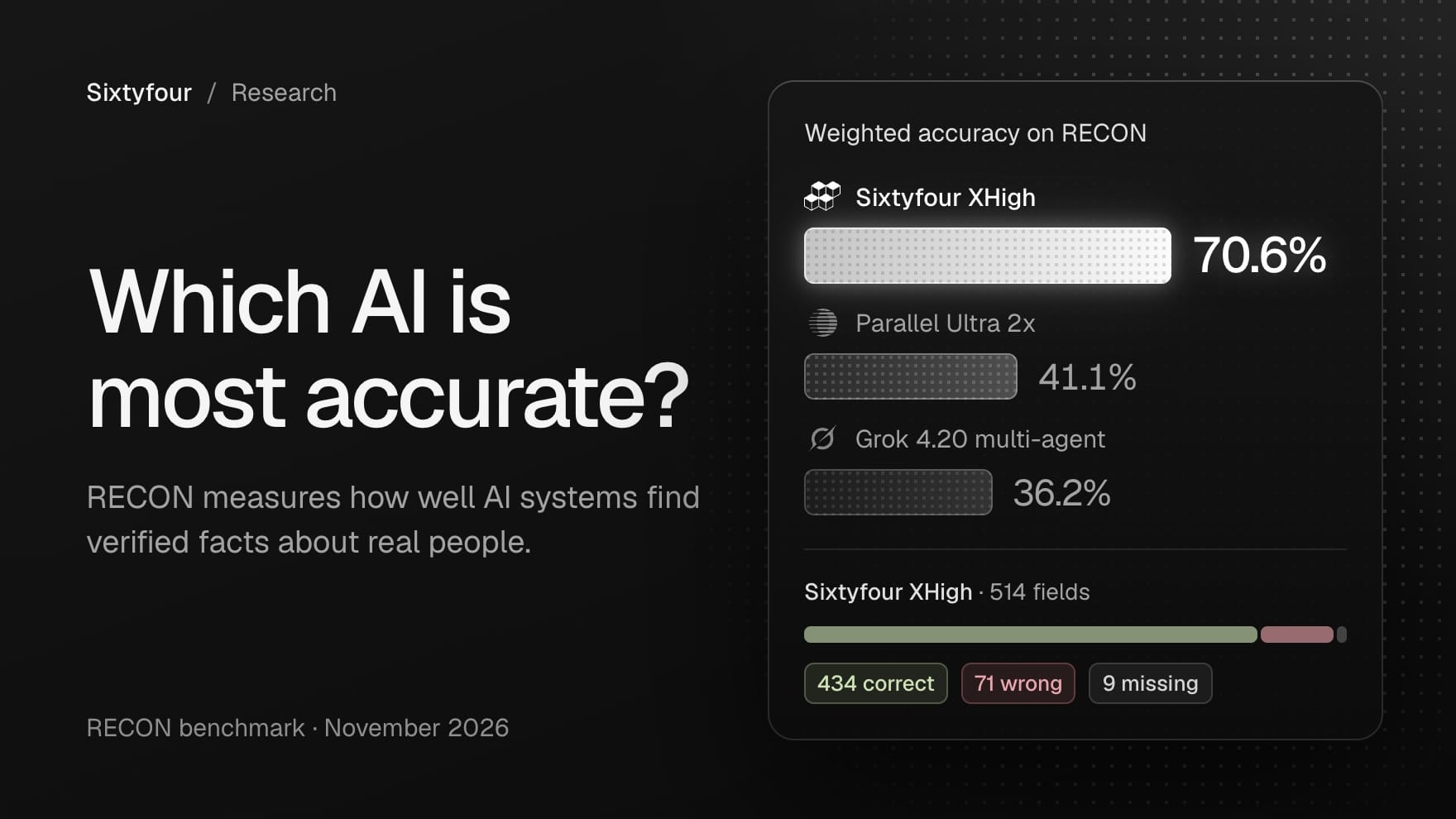
On RECON, our benchmark of 514 verified facts about 140 real people, Sixtyfour XHigh has the highest weighted accuracy of the 23 systems tested: 70.6 percent, with 434 correct, 71 wrong and 9 missing. Every general-purpose model, which here means an AI lab's own model called through its API with web search, scored lower: the strongest from xAI, Moonshot, Anthropic, OpenAI and Google were Grok 4.20 multi-agent at 36.2 percent, Kimi K3 at 27.0, Claude Opus 5.5 at 26.3, GPT-6 Astra at 25.1 and Gemini 3.1 Pro at 13.4. The strongest system from another company is Parallel Ultra 2x, at 41.1 percent. GPT-6 Astra has the highest precision, 90.6 percent, on the 159 fields it answered.
Give Sixtyfour XHigh, the default engine in our Atlas investigations, a name and a few identifying details, and it returns the facts you ask for, each with a confidence score and the sources it was read on. We built RECON, and five of the evaluated configurations are Sixtyfour tiers, so read it as our benchmark. The benchmark page names HUD under "Externally validated by", and HUD ran every configuration with our dataset and public harness. This post gives the full results and explains what each measure rewards, and it ends with advice for getting accurate people research from any assistant.
What does RECON measure?
RECON tests whether an AI system, given a name and a few identifying details, can find specific facts about a real person. The dataset holds 514 verified facts about 140 people across occupations, countries and levels of online visibility. The benchmark page says questions "range from a first employer or an old username to a high-school GPA or a company's original tagline", with answers drawn from profiles, local publications, organisational records and archived websites.
People research has difficulties of its own, and the dataset was built to measure them.
- Same-named decoys. Roughly a quarter of the people are paired with a decoy who shares their name, so a system has to work out which person each page is about.
- Low visibility. We avoided public figures "whose information is too widely indexed to stress-test the benchmark". The people span more than 60 occupational and geographic strata across more than a dozen countries, with digital footprints from heavily indexed to near-invisible.
- Old and local sources. Answers come from archived websites and local publications as well as from profiles and organisational records.
- Strict reference answers. Every field was verified against a primary source with an unambiguous identity link to the person, fields that relied on inference were rejected, and a name or username match alone was not enough to establish an answer.
Each task pairs a person with the fields to find. In the page's words, person_info "gives the agent its ground-truth anchor", and struct defines what it has to return. The page publishes one field from one task: the person is the founder of a small local company, and the field is that company's original tagline. Here is its shape, with the person, the company and the place replaced by placeholders:
{"person_info": "FULL_NAME, founder of COMPANY_NAME in CITY, STATE","struct": {"company_original_tagline": "The company's original tagline"}}
The agent is never given the reference answer. In a selected Sixtyfour run the page describes, local coverage gave the company's former domain, and a 2012 archive of its homepage held the tagline. The page's other selected cases are similar: an architect's illustrations credited under her maiden name in a scanned 1985 book, reached through an archived copy of her firm's publications page, and a violinist's job title and dates read across twelve weekly issues of a church newsletter.
How is each answer scored?
A GPT-4.1 mini judge grades every field as correct, wrong or missing, ignoring differences of format, and it agreed with human review on 98.5 percent of a 200-field sample. A field is missing when the system returns nothing for it. Three measures come from those counts, and each rewards something different.
- Weighted accuracy is correct answers minus wrong answers, divided by all 514 fields. A right answer earns a point, a wrong answer loses a point and a blank earns nothing, so it rewards finding facts and charges for errors at the same rate. The benchmark page calls it weighted accuracy, and the repository's README now calls it net accuracy. This post uses weighted accuracy.
- Precision is correct answers divided by the answers a system gave. It rewards being right when you answer and leaves blanks out, so a system that answers only when it is sure can have high precision without finding many facts.
- Recall is correct answers divided by all 514 fields. The page also calls it standard accuracy, and the repository lists it as accuracy. It rewards finding facts and ignores wrong answers.
The three are linked. Weighted accuracy equals recall minus the share of fields answered wrongly: for XHigh, 84.4 percent recall less 13.8 percent answered wrongly gives 70.6. Because a wrong answer costs as much as a right one earns, an extra answer raises weighted accuracy only when it is more likely right than wrong. Every runner in the public harness for another provider's system tells it to leave a field empty when it cannot find an answer it is sure of. The OpenAI runner's instruction reads: "If you cannot find a definitive answer, return an empty string for that field."
Running people research with Sixtyfour
Sixtyfour XHigh is the default engine in Atlas, which runs deep investigations: research agents build a workspace and an attribution graph on a subject and write a report. The Atlas docs describe XHigh as a "Frontier model and a team of research agents", the deepest research Atlas offers. Analysts run it in the Atlas web app, and developers run it through the API.
In code, XHigh is engine: "xhigh" in the Atlas API and the xhigh tier of People Intelligence. The docs call tier: "xhigh" "a structured version of Atlas": it runs the same agents and creates the same investigation, then returns the fields you asked for in structured_data. RECON's public harness, which HUD used, calls People Intelligence for every Sixtyfour configuration: it sends each task to POST /people-intelligence-async, with person_info as the description in lead_info, the task's fields as struct, field confidence on, and the tier, xhigh for XHigh.
Here is a request in that shape for a person you are researching, from our Atlas integration docs, with the polling helper from our async jobs docs. Put the details you hold in lead_info and one field per fact in struct.
import timeimport requestsAPI = "https://api.sixtyfour.ai"HEADERS = {"x-api-key": "YOUR_API_KEY"}start = requests.post(f"{API}/people-intelligence-async",headers=HEADERS,json={"lead_info": {"name": "FULL_NAME", "company": "COMPANY_NAME", "location": "CITY"},"struct": {"company_original_tagline": "The company's original tagline"},"tier": "xhigh","max_minutes": 60})start.raise_for_status()task_id = start.json()["task_id"]def wait_for_job(task_id, interval=10, timeout=7200):deadline = time.monotonic() + timeoutwhile time.monotonic() < deadline:response = requests.get(f"{API}/job-status/{task_id}", headers=HEADERS, timeout=30)if response.status_code in (429, 503):time.sleep(float(response.headers.get("Retry-After", interval)))continueresponse.raise_for_status()job = response.json()if job["status"] != "running":return jobtime.sleep(interval)raise TimeoutError(f"Job {task_id} still running after {timeout} seconds")job = wait_for_job(task_id)if job["status"] != "completed":raise RuntimeError(f"Job {job['status']}: {job.get('error', 'no reason given')}")result = job["result"]if result["notes"].startswith("Declined:"):print(result["notes"])else:for field, entry in (result.get("field_confidence") or {}).items():if entry:print(field, result["structured_data"][field], entry["confidence"], entry["sources"])
The start response carries the run's investigation and its workspace_url, so you can watch the agents work in the Atlas section of the Sixtyfour app. A run with a struct may stop once every field is answered, and otherwise ends when its credit budget or its time limit, max_minutes, runs out. Setting relentless: true keeps it researching until the budget runs out instead of stopping early. Each answered field comes back in field_confidence with a score from 0 to 100, a justification, its sources and the findings in the investigation's graph that support it. The confidence scoring docs say each score "reflects how much assumption is needed to tie the value back to the target person or company", which is the same-name problem RECON is built around.
When the agents decline to research a subject, the job still reports completed and its notes start with "Declined:", which is why the code checks notes before reading the fields. Atlas is available to Enterprise customers and enabled on request. The other Sixtyfour tiers on RECON are People Intelligence tiers too, which the docs describe this way: High is an open-source intelligence investigation, Scout runs High's research toolset on a lighter, lower-cost model, Medium adds sources and research iterations, and Low is the fast default. If your AI assistant supports the Model Context Protocol, Sixtyfour's MCP server can start an XHigh investigation from inside it once Atlas is enabled for your organisation.
RECON measures research on one person you already have. Finding people who match a description is a different job, and our search benchmark post covers it.
What are the full RECON results?
Figure 1 shows every Sixtyfour tier and the strongest configuration from each other provider, and Table 1 lists all 23 configurations on the benchmark page, last updated on 10 October 2026, in order of weighted accuracy. We recomputed every percentage from the correct, wrong and missing counts, and each matches the page.
Weighted accuracy per system on RECON. All Sixtyfour tiers and the strongest result per external provider are shown; Table 1 lists every configuration. Sixtyfour systems are light; external systems are dark.
| # | System | Weighted accuracy | Precision | Recall | Correct / Wrong / Missing |
|---|---|---|---|---|---|
| 1 | Sixtyfour XHigh | 70.6% | 85.9% | 84.4% | 434 / 71 / 9 |
| 2 | Sixtyfour High | 54.3% | 83.5% | 67.7% | 348 / 69 / 97 |
| 3 | Sixtyfour Scout | 48.4% | 78.8% | 66.3% | 341 / 92 / 81 |
| 4 | Sixtyfour Medium | 44.7% | 83.2% | 56.0% | 288 / 58 / 168 |
| 5 | Parallel Ultra 2x | 41.1% | 80.4% | 54.3% | 279 / 68 / 167 |
| 6 | Parallel Ultra 8x | 37.5% | 78.1% | 52.1% | 268 / 75 / 171 |
| 7 | Grok 4.20 multi-agent | 36.2% | 77.0% | 51.6% | 265 / 79 / 170 |
| 8 | Grok 4.6 | 36.0% | 77.4% | 50.8% | 261 / 76 / 177 |
| 9 | Grok 4.3 | 30.9% | 76.2% | 44.9% | 231 / 72 / 211 |
| 10 | Sixtyfour Low | 28.8% | 70.3% | 49.8% | 256 / 108 / 150 |
| 11 | Parallel Ultra | 27.2% | 72.9% | 43.4% | 223 / 83 / 208 |
| 12 | Kimi K3 (max) | 27.0% | 80.1% | 36.0% | 185 / 46 / 283 |
| 13 | Claude Opus 5.5 (xhigh) | 26.3% | 83.3% | 32.9% | 169 / 34 / 311 |
| 14 | GPT-6 Astra (max) | 25.1% | 90.6% | 28.0% | 144 / 15 / 355 |
| 15 | Exa agent xhigh | 23.9% | 73.2% | 37.7% | 194 / 71 / 249 |
| 16 | GPT-6.1-sol max | 23.0% | 85.1% | 27.8% | 143 / 25 / 346 |
| 17 | GPT-5.6-sol xhigh | 20.4% | 74.2% | 31.3% | 161 / 56 / 297 |
| 18 | Gemini 3.1 Pro (high) | 13.4% | 70.4% | 23.2% | 119 / 50 / 345 |
| 19 | Claude Sonnet 5 (xhigh) | 12.6% | 73.0% | 20.0% | 103 / 38 / 373 |
| 20 | DeepSeek V4 Flash (high) | 12.5% | 75.0% | 18.7% | 96 / 32 / 386 |
| 21 | DeepSeek V4 Pro (high) | 12.3% | 74.0% | 18.9% | 97 / 34 / 383 |
| 22 | GLM 5.3 (max) | 3.7% | 57.7% | 13.8% | 71 / 52 / 391 |
| 23 | Claude Haiku 4.5 | 1.6% | 55.7% | 7.6% | 39 / 31 / 444 |
HUD conducted all runs between September 8 and October 6, 2026. Each configuration reports its most recent complete, technically valid run across all 140 people and 514 fields.
What do the results show?
On RECON, the systems differ far more in how many facts they find than in how often their answers are right. Twenty of the 23 configurations have precision between 70 and 86 percent, and among those 20, recall runs from 18.7 percent to 84.4. Across all 23, precision spans 34.9 points and recall 76.8.
GPT-6 Astra answered fewer fields and was right on more of them. It gave an answer for 159 of the 514 fields, 31 percent, and 144 of them were right. XHigh answered 505 fields, 98 percent, and 434 were right. XHigh found 290 more facts than GPT-6 Astra and gave 56 more wrong answers, so it is ahead on weighted accuracy and recall while GPT-6 Astra is ahead on precision.
Precision is correct answers divided by all nonblank answers. Recall is correct answers divided by all requested fields. All Sixtyfour tiers and the strongest result per external provider are shown; Table 1 lists every configuration.
Most general-purpose models left most fields blank. Fourteen of the 23 configurations are general-purpose models in the sense used above, an AI lab's own model called through its API; the other nine are dedicated research systems from Sixtyfour, Parallel and Exa. Eleven of the 14 left more than half of the 514 fields empty: GPT-6 Astra 69.1 percent, Gemini 3.1 Pro 67.1, Claude Opus 5.5 60.5 and Kimi K3 55.1, for example. The exceptions are xAI's three Grok configurations, at 33.1 to 41.1 percent. Every RECON field has a verified answer, so each blank is a fact that exists and was not returned. XHigh left 9 fields blank, 1.8 percent.
The penalty for wrong answers changes the order. Sixtyfour Low found more facts than Grok 4.3, with recall of 49.8 percent against 44.9, but its 108 wrong answers are the most of any configuration and put it below Grok 4.3 on weighted accuracy, 28.8 percent against 30.9. Kimi K3 found fewer facts than Exa's agent, 36.0 percent recall against 37.7, and ranks above it, 27.0 against 23.9, because it gave 46 wrong answers to Exa's 71.
The six highest configurations are dedicated research systems: four Sixtyfour tiers and two processors of Parallel's Task API, which Parallel's docs say "is designed for asynchronous, accuracy-critical research" (checked 4 November 2026). Within Sixtyfour's own tiers, XHigh and High have similar precision, 85.9 and 83.5 percent, and XHigh's lead comes from recall, 84.4 percent against 67.7.
How do you get accurate people research from an AI assistant?
RECON's design doubles as a checklist. These habits follow from how the benchmark is built and graded, and they apply to any assistant, ours included.
- Anchor the identity. Give a full name with the details that separate this person from others who share it, such as an employer, a role and a city, the way RECON's
person_infodoes. A name on its own is a search for everyone with that name. - Ask for one specific fact at a time. Our People Intelligence docs note that a field described as "The individual's primary work email" beats one described as "email", and the same holds for a prompt.
- Let it say unknown. Tell the assistant to leave a fact blank when it cannot find an answer it is sure of, as the RECON harness tells each system from another provider to do. A blank shows you where to look next, and a confident wrong answer has to be caught before anyone relies on it.
- Ask for a source for every answer, and open it. A cited answer can still be wrong. Our guide to evaluating AI tools for investigations suggests taking twenty findings, opening every source and counting how many support the claim as written.
- Check that each source is about your person. Roughly a quarter of RECON's people have a same-named decoy, and a name or username match alone was not enough to establish any of its reference answers. Ask what ties each page to your person beyond the name, such as an employer, a city, a date or a photo, and treat an answer without that link as a lead. Our guide to identity resolution explains how to weigh each link.
- Point it at archives and local sources. RECON's sample tagline was on a 2012 archive of a homepage, found through local coverage. Ask the assistant to check archived versions of any site it finds, and local publications where the person lives and works.
- Test it on people you know. RECON scores systems against answers verified in advance. Run your assistant on a few people whose facts you can check, and count how often it is right, wrong and blank before you trust it with someone new.
Sixtyfour builds several of these into each run. The lead_info you send is the anchor, each struct field is one specific fact, every answered field carries its sources and a confidence score, and what the agents could not establish is reported as open for a person on your team to decide.
Reading the results fairly
RECON measures one job carefully, and a few things are worth keeping in mind when you use its numbers.
- We built it. Sixtyfour designed RECON and its dataset and offers five of the 23 configurations. The benchmark page names Sixtyfour under "Built by" and HUD under "Externally validated by", and HUD ran every configuration between 8 September and 6 October 2026 using our dataset and public harness. The harness is on GitHub, and the dataset is available on request because it contains personal information.
- Close scores are close. With 514 fields, one field is worth about 0.19 points of weighted accuracy. Grok 4.20 multi-agent and Grok 4.6 are one net answer apart, and so are DeepSeek V4 Flash and V4 Pro.
- It is a snapshot. Each score comes from a single run in the evaluation window, and the page was last updated on 10 October 2026. The page notes that scores reflect each system's tools and configuration as well as its underlying model, and that "source availability and run-to-run variation can also affect results." Providers change their models and tools, so a later run may come out differently.
- The judge is a model. GPT-4.1 mini agreed with human review on 98.5 percent of a 200-field audit, 197 of the 200 fields, so a small share of verdicts in any run may be wrong in either direction.
- Some systems declined. Claude Opus 5.5 returned an API refusal for 7 of the 140 people and, for 9 more, replied without searching that the details were private. GPT-6 Astra left 19 people blank without searching. The page says "these runs alone do not establish their cause or the models' research ability on requests they accept."
- It measures retrieval of specific facts. Writing a full research report needs separate evaluation, and cost and latency are outside the benchmark's scope.
- Our own systems make mistakes. XHigh gave 71 wrong answers, and the page shows one: it found a business owner's full German job title at her former firm and returned the shorter heading. Sixtyfour Low gave 108 wrong answers, the most of any configuration.
- Apps were not tested. RECON ran models through their providers' APIs, and the ChatGPT, Claude and Gemini apps are not in it. A product built on one of these models may use different tools and settings. Perplexity and Elicit were not evaluated either.
- The repository lists 20 of them. Its results table has 20 of the 23 configurations, with the same counts, and Claude Opus 5.5, GPT-6 Astra and GPT-6.1-sol max are on the benchmark page only.
The short version
On RECON's 514 verified facts about 140 people, Sixtyfour XHigh has the highest weighted accuracy, 70.6 percent, against 41.1 percent for Parallel Ultra 2x and 36.2 percent for the strongest general-purpose model, Grok 4.20 multi-agent. GPT-6 Astra is the most precise, at 90.6 percent on the 159 fields it answered, and most of the difference between systems is in how many facts they find. Whichever assistant you use, anchor the identity, ask for sources, let it leave gaps and check that every answer is about your person. Sixtyfour XHigh, through Atlas or the People Intelligence API, does that research and returns each fact with its sources and a confidence score.