A credible identity is the start of the investigation
A candidate can have a real identity and a long-standing online presence while their application still contains claims that need checking. For a hiring platform screening applicants at scale, identity verification and résumé verification are separate questions.
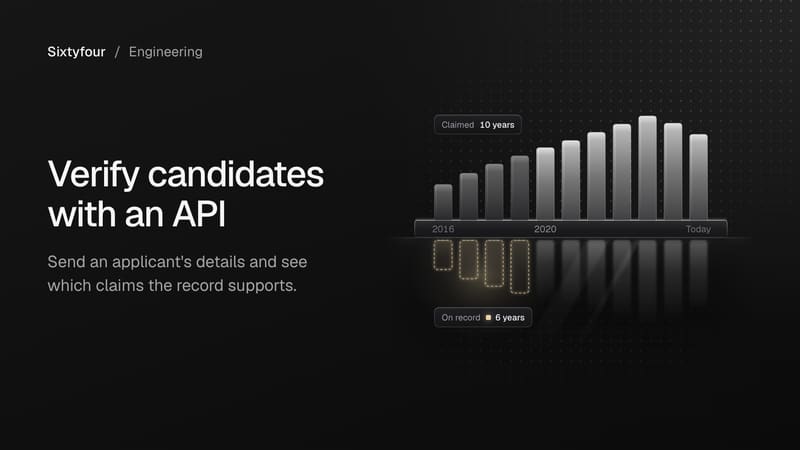
The platform connected Sixtyfour to its screening pipeline to research those questions within an existing workflow. Applicant information, including contact details, profile information and résumé text, is submitted to a saved research workflow through an API webhook.
That integration gives the platform a structured way to investigate employment, education and identity consistency, then return an assessment with the supporting rationale.
Research inside the screening workflow
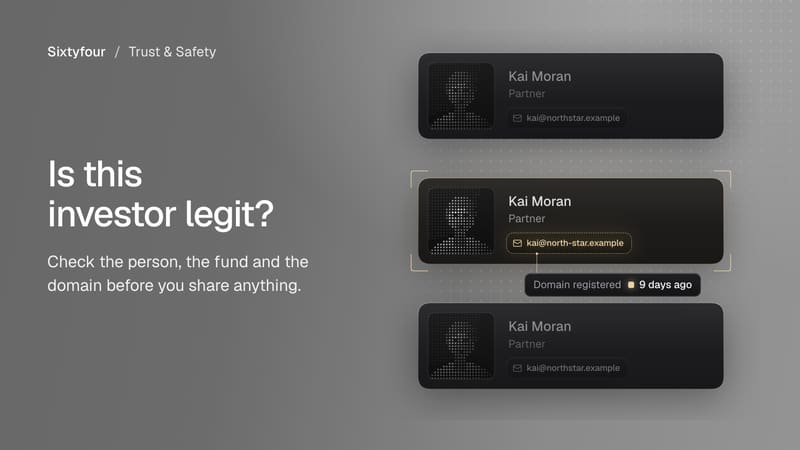
Sixtyfour's research agent is instructed to assess individual claims against public sources, including company-registry data. It can use reverse email and phone tools where relevant and look for signals of impersonation. Those tools are available to the agent; they are not mandatory steps in every check.
A separate assessment step converts the research into a category, score, confidence level, red flags and written explanation. These outputs describe the workflow's assessment of the evidence. They do not, by themselves, establish fraud or record a hiring decision.
The configuration makes several useful distinctions. A name mismatch in a reverse lookup cannot be the sole basis for a fraud classification. A missing professional profile is treated as neutral. An unverified claim remains missing information.
Later versions created in the customer's account added research fields and refined assessment rules. The production configuration reflects an evolving screening process, with research and classification handled as distinct steps.
What one screening surfaced
In one completed check, the identity signals pointed to a real person. The public profiles were long-standing, though thin, and the available contact and location signals aligned.
The employment and education details raised further questions. Company-registry data obtained through public lookup sites showed an incorporation date later than the claimed employment start. The applicant's own professional profile also listed different work and education details from the résumé.
Those discrepancies needed interpretation. The registration gap fell within the workflow's stated tolerance, and the research had also found an earlier company associated with the applicant. It did not establish whether work at that related business explained the timeline. The difference in job titles was not evidence of title inflation.
Under the configured assessment rules, partial contradictions in two areas produced a fraud classification. The available record does not show whether the discrepancies were subsequently resolved or what decision the customer made.
The finding is therefore specific: Sixtyfour surfaced differences across sources and returned the reasoning behind the assessment. The example illustrates the importance of reading that reasoning alongside the classification.
An established production integration
Production records show thousands of completed checks over a measured two-week period. This demonstrates ongoing use of the screening integration. The records do not establish time saved, detection accuracy or financial return.
The practical value of the workflow is the evidence it brings into the screening process: identity signals, employment and education research, and a structured explanation of where claims align or differ. It gives the platform a research record to work from while keeping unresolved questions visible.