
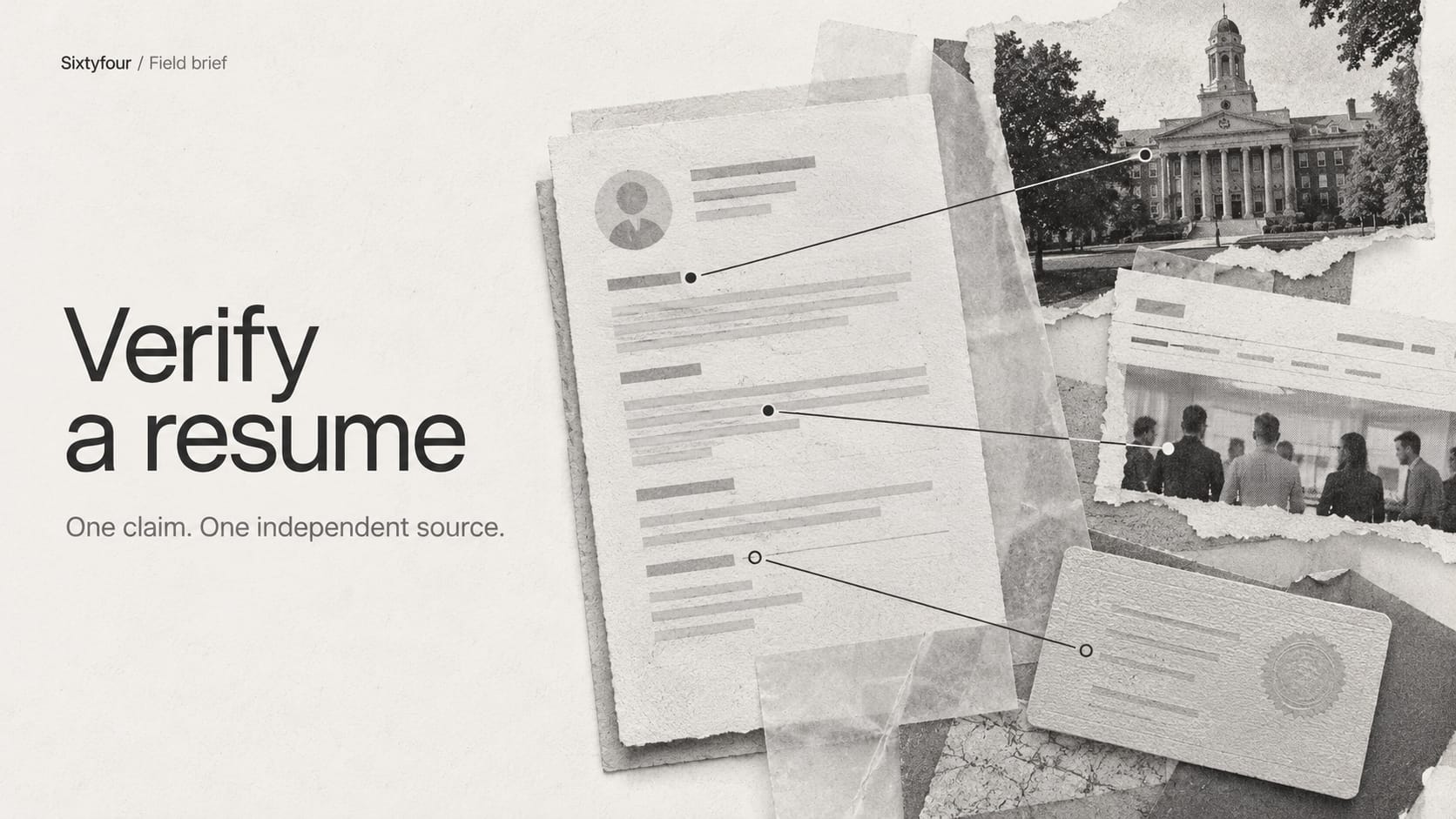
To verify a resume, treat it as a list of separate claims and check each one against a record the candidate did not write: the registrar for a degree, the issuing board's register for a licence, company registries and archived copies of the employer's own website for a job, and the project's own history for open-source work. Confirm anything that is not public, such as employment dates or a transcript, with the employer or school directly and with the candidate's consent. Then mark each claim as confirmed, explained or open, and ask the candidate about anything that does not line up.
This guide assumes the person is real and asks whether their claims hold up. Whether the person behind an application is who they say they are is a separate question, covered in our guide to spotting fake candidates before the interview.
How to verify a resume, one claim at a time
Job seekers stretch claims more often than they invent them. Christine Henle, Brian Dineen and Michelle Duffy ran three anonymous surveys, two of US business students and one of working adults who had recently found a job. On average, 72 percent said they had embellished their resume in their current or most recent job search to at least some extent, 61 percent had left relevant information out, and 31 percent had fabricated information (Journal of Business and Psychology, 2019). The authors define fabrication as intentionally falsifying information, such as listing a degree never earned, and embellishment as exaggerating otherwise accurate information, such as overstating involvement in a project.
The same paper notes that checking only one kind of claim, such as degrees, leaves the rest undetected, and that some claims, such as how involved someone was in a project, may be hard to confirm.
So start by writing the resume out as claims. "Senior engineer, Quillmere Data, 2019 to 2022" is three of them: an employer, a title and a pair of dates. Each can hold up while another does not.
| Claim | Who can confirm it | Public trace to look for |
|---|---|---|
| Employer and dates | The employer, with the candidate's consent | Company registry, archived team pages, bylines and conference bios |
| Job title | The employer | Archived team pages, talk and paper bios |
| Degree | The school's registrar | The school's accreditation, though not the degree itself |
| Professional licence | The board that issued it | The board's public lookup |
| Certification | The issuer, from a credential ID or badge link | Often nothing you can search by name |
| Open-source work | The project | Reviewed pull requests, the maintainers list |
| Talks, papers, patents | The organiser, publisher or patent office | The programme, the paper, the patent record |
| Scope ("led", "owned", "grew") | Colleagues and references | Rarely anything |
Put most of the effort where fabrication is possible: employers, titles, dates, degrees and licences. Scope claims matter too, but interviews and references test them better than records do.
Which claims leave a public footprint
Weigh every record by who wrote it and when. A conference programme from 2021 that lists someone with their employer was written by the organisers at the time. A blog post the candidate published in 2019 was written by them, but before this application existed. A profile updated last month was written by the candidate for this job search, and counts for least.
The size of the employer changes what you can find. A role at a company of thousands rarely shows on the company's own website, so any trace is the person's own: a talk, the affiliation line on a paper, a profile kept for years. A 30-person startup is often the opposite. Its team page may have listed everyone, it may since have closed or been acquired, and archived copies of its site may be the best record left.
Open-source work can leave a detailed trace, and it needs careful reading. GitHub places a commit on a profile by its author date, and Git lets whoever makes a commit override that date. A profile's graph can also include private contributions, shown as daily counts with no detail. So treat the graph as a summary. The stronger evidence is inside the project: pull requests that other maintainers reviewed and merged, and the commit that added the person to the maintainers list.
Talks, papers and patents carry their own dates and affiliations. Check the conference's own programme and the paper itself. US patents can be searched by inventor in the USPTO's Patent Public Search, which from 7 November 2026 can only be used while signed in to a USPTO account.
How to verify degrees, licences and certifications
Start by checking that the school is real and accredited. The US Department of Education's Database of Accredited Postsecondary Institutions and Programs (DAPIP) holds information reported by recognised accrediting agencies and state approval agencies. The Department notes that this information is not audited, and that institutions outside the United States are not included. The Council for Higher Education Accreditation (CHEA) keeps its own database of accredited institutions and programmes, plus an international directory of more than 500 quality assurance bodies, accreditation bodies and ministries of education around the world, which is where to start with a degree from abroad. Accreditation can be faked too. The FTC warns that some fake degree programmes make up an accreditor or lie about being accredited by a real one, and that some diploma mills use names very close to those of well-known universities.
Then confirm the degree with the school. The FTC's guide for employers says most registrars will confirm dates of attendance and graduation, degrees awarded and majors, and that with the applicant's permission they may provide a certified transcript. Find the registrar through the school's own website, because the same guide notes that some diploma mills offer a "verification service" that sends a fake transcript to employers who call. US colleges can hand degree verification to the National Student Clearinghouse, a nonprofit founded by the higher education community, which answers from the records schools send it and puts its coverage at 96 percent of US four-year degrees.
Licences are issued by boards, and boards often publish a lookup. California's engineering board, for example, points anyone checking a licence to the lookup on its website. CPAs can be checked in CPAverify, a free search hosted by the National Association of State Boards of Accountancy with data sent by the state boards (53 jurisdictions took part as of March 2026). Check the name, the status, and that the licence covers the state and discipline the resume claims.
Certifications often cannot be looked up by name. AWS, for example, does not provide a list of certified people, and asks anyone verifying a certification to request the holder's digital badge link. Ask for the credential ID or link, and check it through the verification route the issuer gives.
How to verify employment history
Work through five questions, in this order.
Did the employer exist at the time? Company registries date it. Delaware's free entity search gives an incorporation or formation date, and the UK's Companies House shows the date of incorporation and previous company names free of charge. A company incorporated after the claimed start date needs an explanation, and there may be an ordinary one, such as a founding team that worked together before it incorporated.
Was the person there? The employer's own website from the time is the best public witness, and the Internet Archive keeps old copies. Its help centre explains how to list everything archived from a site, which turns up old team, about and blog pages. The archive is incomplete and says so: some sites are missing because its crawlers did not know they existed. Its Save Page Now feature also lets anyone save a page, so a capture of a page the candidate controls shows that the page existed on that date, and nothing more.
Who else recorded it? Conference programmes, papers with affiliation lines, press releases and engineering blog posts with bylines all name people and employers at a date, and someone other than the candidate wrote them.
What did the candidate say at the time? A profile kept for years, especially one archived along the way, shows what they said about a job while they held it. Our guide to investigating an email address covers finding the accounts behind one identifier.
What does the employer say? Dates and title come from the employer, through contact details you find yourself, once the candidate has agreed to the check.
A worked example
The candidate, companies and project in this example are invented.
Tamsin Arlecourt applies for a remote senior backend role. Her resume claims:
- Staff engineer at a large payments company, September 2022 to now, where she "led the migration of the settlement ledger to a new database".
- Senior engineer at Quillmere Data, a 30-person analytics startup, January 2019 to August 2022.
- A master's in computer science, completed online in 2018 at a US state university.
- Maintainer of an open-source database migration library since 2021.
- A talk at a regional engineering conference in 2021.
The degree. The university is listed in DAPIP with a recognised accreditor, and with Tamsin's consent the registrar confirms the master's and its 2018 date. Confirmed.
The open-source work. Her merged pull requests in the project start in 2020, reviewed by two other maintainers, and a 2021 commit by the project's founder adds her to the maintainers file. Her contribution graph goes back to 2014, which on its own would not have counted. Confirmed.
The talk. The conference's 2021 programme, still on its website, lists "Tamsin Arlecourt, Quillmere Data", and the recording is on the conference's channel. Confirmed, and it also places her at Quillmere in 2021.
Quillmere. Its website, quillmere.example, now redirects to the company that acquired it in 2022. The Delaware registry shows it incorporated in 2016, before her claimed start. Archived captures of its team page list her from October 2019 onwards, and captures from early 2019 do not. The acquirer's HR team, contacted with her consent, confirms her as a senior engineer from July 2019 to August 2022. The resume's start date is six months earlier than the employer's record, so that goes to the candidate as a question.
The payments company. With her consent, it confirms her dates and title. Nothing public mentions the ledger migration, which is not unusual for internal work at a large company.
Asked about the start date, Tamsin explains that from January to June 2019 she worked on Quillmere's team as a contractor, placed there by a contracting firm, and was hired in July. She names the firm, which confirms the placement. The US Bureau of Labor Statistics counts this arrangement as workers provided by contract firms: people who work for a contract company, are usually assigned to only one customer, and usually work at that customer's worksite. Her resume folded the contract into the job.
| Claim | Evidence | Status |
|---|---|---|
| Master's, 2018 | Accreditation listing, registrar | Confirmed |
| Open-source maintainer since 2021 | Reviewed pull requests, the commit adding her as a maintainer | Confirmed |
| 2021 talk | The conference's own programme and recording | Confirmed |
| Quillmere, January 2019 to August 2022 | Registry, archived team page, the acquirer's HR, the contracting firm | Explained: contractor January to June, employee from July |
| Payments company, dates and title | Employer confirmation | Confirmed |
| Led the ledger migration | Nothing public | Open |
The open claim becomes an interview topic: what the migration involved, which decisions were hers, and who else worked on it. With her agreement, a reference from that team can speak to it.
What a mismatch can mean
Many mismatches have an ordinary cause. Henle and colleagues leave unintentional errors, such as forgetting the dates of jobs held long ago, out of their definition of resume fraud, and note that misrepresentations can come from honest mistakes, poor advice from placement services or forgotten information.
| Mismatch | Common innocent cause | What to ask for |
|---|---|---|
| Start date earlier than the employer's record | A contract period through an agency, or dates rounded to the year | The agency's name, a contract or an offer letter |
| Company not found under that name | Renamed, acquired, or trading under a name other than its registered one | The former name or the acquirer |
| Title differs from the employer's record | Internal titles often differ from the ones used on resumes | The internal title and level |
| No degree record found | A name change since graduation | The name used at the school |
| Overlapping roles | Part-time work, consulting, a notice period | Which role was full-time |
| A gap | Study, caring, illness, a long search | What they were doing, if they choose to say |
Fabrication tends to look different, and it survives the candidate's explanation: an employer with no trace in any registry, archive or third-party record, a school whose only accreditor is not recognised, a licence missing from the board that supposedly issued it, or a record that contradicts the resume outright.
How to ask the candidate about gaps and discrepancies
Ask about one thing at a time, and say what you found. "Our record shows you starting at Quillmere in July 2019, and your resume says January. Can you tell us about those months?" gives the candidate room to explain, and the explanation usually comes with something you can check.
For anything beyond public information, such as contacting a former employer, asking a registrar to confirm a degree or requesting a transcript, tell the candidate what you plan to check and get their consent first. It is courteous, and candidates can often point you to a faster route, such as the agency that paid them or the name they studied under.
Reading the results fairly
This method finds what was recorded, and plenty of real careers leave little record. Engineers at large companies rarely appear on their employer's website, and some people keep no public profiles at all. Startups close, their domains lapse, and the archive has gaps of its own. Names change with marriage, and transliteration can give one name several spellings in different countries.
So keep three outcomes apart. Confirmed means a record the candidate did not write agrees with the claim. Explained means a mismatch has an ordinary cause that you have checked. Open means you found nothing either way, and an open claim moves to the interview and the references.
Where Sixtyfour fits
Checking a resume by hand means working through registries, archives, repositories and programmes, one claim at a time. Sixtyfour's agent starts from what the application already contains, such as the candidate's email address, name or code-hosting username, researches public sources, and links what it finds to the same person. Every finding comes with its source, and anything it could not establish is reported as open rather than filled in. The results go to your hiring team, and a person decides what to ask and whether to proceed. There is more on how hiring teams use it on our workforce identity page.
The short version
Write the resume out as claims, and check each one against a record someone else wrote, weighed by who wrote it and when. Confirm details that are not public with the employer or school once the candidate agrees. Mark each claim as confirmed, explained or open, and ask the candidate about the rest before you decide anything.